Contributors

Showing posts with label Congress. Show all posts

Friday, 3 April 2015

Presidential Foreign Policy - Obama and Iran

President Obama's recent negotiations with Iran and the rest of the "P5+1" (US, UK, France, Germany, China and Russia) have come up with a "historic" agreement to stop Iran from building a nuclear bomb. 

Certainly a good example to use when discussing the power of the president and foreign policy; however, there is still much work to be done and this is not actually an agreement as such. It is an agreement to continue working towards an agreement.

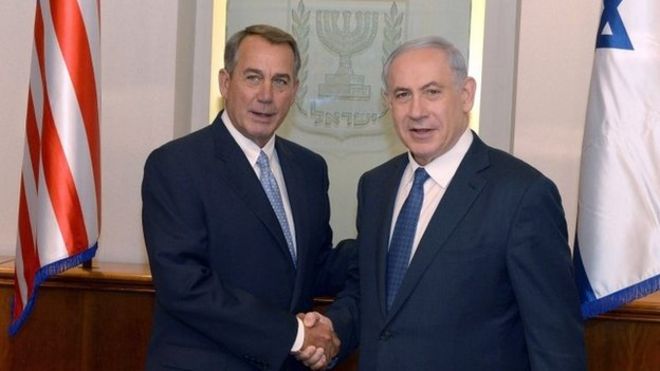
Of more use for any G and P student working towards Unit 4C is the idea that Congress can scupper the deal; Israeli Prime Minister Benjamin Netanyahu's speech to Congress essentially went over the head of the President and was an appeal to Congress (or more specifically the Republican-dominated Congress) not to allow Obama to leave Israel weakened.
Republican Speaker Boehner & Israeli PM Netanyahu.
Picture Credit: BBC

As a result, the President is likely to find it hard to get any Iran deal through Congress - although there may be technical ways of avoiding or limiting the Republican Party's power, the Senate has the power of "advice and consent" over treaties negotiated by the President.

Further analysis by the NY Times here, Netanyahu's comments about the agreement here, and the BBC analyses the power of Congress here.

Great stuff for any G and P student contemplating Presidential power over foreign policy.

Wednesday, 10 December 2014

Senate Report on Torture

The Senate, in its last days before becoming Republican-dominated, has just published a report into the interrogation techniques used by the CIA after 9/11.

G and P students should bear this in mind when considering the effectiveness of Congress's oversight of the Executive; finally these techniques are called "torture". However, according to Rolling Stone no-one will get prosecuted for it.

The article discusses the likelihood of the Obama administration being investigated for similar things in future, and reckons it's probable. However, this all may be more about political partisanship than effective oversight by the legislature.

Fascinating stuff.

Thursday, 6 November 2014

Mid-terms 2014

The Mid-terms saw both the House and the Senate being controlled by the Republicans. Further detail about races and the overall view here from the BBC. For example, Democratic Representative for New York Louise Slaughter, an experienced member of Congress, won by the narrowest of margins; 50.2% to 49.8%. "Blue-Dog" Democrat John Barrow lost, meaning that conservative Democrats are largely extinct in Congress.

What are the prospect for the US Government in the next two years? President Obama and new Senate Majority Leader Mitch McConnell have pledged to work together on issues they both agree in (tax reform and foreign trade pacts).

Further analysis here from the Economist, which highlights the problem - the Tea-Partiers and others may not allow the two to work together. Rolling Stone magazine discusses this very issue here, and looks forward excitedly to the battle within the Republican Party and the Presidential election of 2016.

All of which is great for G and P students contemplating the powers of Congress and the President for Unit 4C and elections in Unit 3C. If there is continued gridlock (something the Republicans are trying to blame on the Democrats), the President may well use executive orders to get things done; for example on immigration.

It must be borne in mind, however, that the turnout for these mid-terms is very low, and is lower than the last mid-terms in 2010 (there is a great map and selection of graphs on this page). Overall, it was 36.6% down from 40.9%; somewhat predictably, Democrat-supporting voters were the least likely to turnout to vote.

As a final note, Rolling Stone's October issue had a great article by Economist Paul Krugman favourably evaluating the Obama Presidency. Well worth a read.

Monday, 22 September 2014

Congress - the gridlock.

I've just come across a great post by the Democracy in America blog on the Economist's web-site which discusses the gridlock in Congress. Great stuff for anyone contemplating this topic in Unit 4C. The article summarises the findings of a study from the Brookings Institution which came to the conclusion that polarisation of politics is increasing because there are fewer and fewer links between politicians. This leads to less cooperation and compromise:

“IF I sponsor a bill declaring apple pie American, it might fall victim to partisan politics,” declared Barack Obama over the summer. 
Picture credit: Brookings Institution

Great stuff.

However, it must be born in mind that Congress does sometimes pass laws with bipartisan support. A good example would be the July 2014 Workforce Investment Act passed by 415-6 in the House and 95-3 in the Senate - this is a bill to help workers and the unemployed get training to the tune of $3bn per year. Further info can be found here.

In August 2014, there was bipartisan support for airstrikes on Iraq in order to take action against ISIL.

It must be noted that these events are rare and that is why headlines are made when laws are passed with the support of both parties.


Monday, 8 September 2014

Presidential Power and the US system

Any G and P student contemplating Presidential power should consider that President Obama has decided to make executive order about the hot-button issue of immigration because it's the right thing to do...  after the mid-terms.

This may show the limits to the President's power, especially given the poor state that the US political system is in; the Democracy in America blog discusses this issue; specifically blaming the two-party system and the lack of 3rd or 4th parties which would encourage compromise. More about it here. A good topic to be on top of for Units 3C and 4C.

Wednesday, 29 January 2014

State of the Union 2014

Just because I can, here is a video of some highlights from the State of the Union address 2014:


Essential viewing for any G and P student contemplating the power of the US president - especially as he approaches the Mid-terms and the final quarter of his presidency when he will be a "lame duck". The BBC's analysis can be found here.

The Washington Post analyses here, leading with the pledge that Obama will act, without Congress if necessary, to help alleviate inequality in the USA. G and P students should be aware of the methods the President would be likely to use - Executive Orders and directing the relevant departments.

Students should also not forget the Clinton-era description of these powers as "Stroke of the pen, law of the land. Kinda cool".

The threat by the President to go it alone without Congress is also a reflection on Congress' willingness to act. G and P students could also use this to help analyse whether Congress is effective.

The complete Address can be found below, courtesy of PBS and Youtube.

Sunday, 8 December 2013

Partisan Politics in the US Congress

In brief, the Economist this week had a great graph in the print edition that showed the partisanship of Congress in an extraordinary way:


 Picture: Renzo Lucioni, Imgur.com 

A Harvard Computer science student created a graph that shows the relationships between members of the Senate, indicating who is more bi-partisan, and who is not. Each dot is a member of the Senate, and the lines indicates a similarity between them and other members of the Senate.

Rather like a single cell dividing in biology, it is very clear over time that the two parties are separating, with fewer members of the Senate "crossing the floor" to cooperate with their opponents.

Compare the Senate voting behaviour of 1989 and 2013. Very useful for any G&P student contemplating the nature of Congress for Unit 4C, and whether it is effective or not. Is a Senate whose members do not cooperate with eachother, but instead behave as though they were in a parliamentary system, what the Founding Fathers wanted?

The Economist posted a video which discusses it:


Thursday, 10 October 2013

Congress procedure and the Republican Party

I just came across another great article from RollingStone Magazine - this time it concentrates on the inner workings of the Republican Party. Although probably more for political obsessives than G & P students it does contain some great nuggets.

I thought it was worth a separate post because it discusses representation in the House, and it uses as an example a House Representative from the Tea Party wing of the Republican party, Justin Amash:

Rep. Justin Amash.
Image: Wikimedia Commons
He has a wide following on social media, which he uses to communicate directly with his constituents, explaining every vote he casts, in detail, on his Facebook page. Mostly, Amash votes no – including 136 times against the Republican Party line. Visiting the congressman that afternoon in his office – decorated with a framed poster of Ayn Rand – I ask him how he can so casually defy leadership. "Why be for leadership?" Amash asks. "It's more popular in your district to be against leadership. Better just to vote your constituency."
 Great for using as an example in Unit 4C when discussing Congressional representation.

The article also discusses at length the how the Tea Party wing of the Republican Party has essentially taken over, by creating a separate group in Congress it calls the Republican Study Committee, which has 174 of 232 House Republicans. This is the group who is apparently running the show when it comes to the current budget crisis.

Specifically this would be a useful example when discussing the different factions of the two political parties.

The article also goes on to describe how otherwise loyal republicans are now branded "RINOS" (Republicans in Name Only), even if they have been given a 97% loyal rating by the American Conservatives Union - the example given is House Rules Committee Chair Pete Sessions.

A final area which G & P students should find useful is how the removal of "pork barrel" spending (a subject of a 15-mark question in Unit 4C) has meant that the leadership of the parties (or specifically in this case the Republicans) have much less leverage over their members.

Few!

Monday, 7 October 2013

13 Reasons why the US government isn't working

Fig 1 - Filibusters and Cloture motions 1917-2012.
Source - washingtonpost.com
I've just come across this article in the Washington Post. It details 13 reasons the US government isn't working. 

Although a round-up of the usual suspects, it is a pretty useful run-down of a variety of causes, including the polarization of the political parties (the graph below shows this pretty well), the Tea Party, gerrymandering in the House and the filibuster.

The conclusion it comes to is pretty startling, but on the whole, a very useful article for anyone contemplating the US government, Congress and the power of the President in unit 4C.
Fig 2 - Average party political position
Source - washingtonpost.com

In a long article in the New York Review of Books, Elizabeth Drew discusses the impact that low turnout has had on US politics - the short version is that it has encouraged the extremist wings of the parties to get out the vote and this in turn has made the political system more polarized. It does have some extraordinary tales of political skulduggery, but in general it has some of the same thrust as the earlier post in the Washington Post.

Esteemed economist Paul Krugman in the Washington Post describes the Republican Party "incompetence", and links to a review of a book by Mann and Ornstein called "It's even worse than it looks". G & P students may have come across the idea of Congress as "the Broken Branch" - these are the two authors who came up with the phrase. They have some very unpleasant things to say about the Republicans:

Today’s Republicans in Congress behave like a parliamentary party in a British-style parliament, a winner-take-all system. But a parliamentary party — “ideologically polarized, internally unified, vehemently oppositional” — doesn’t work in a “separation-of-powers system that makes it extremely difficult for majorities to work their will.”

Food for thought, and probably essential reading for the 2013 exams.

Update - 10th October 2013

RollingStone Magazine has published a very long article putting the current division between political parties into historical context. Essential reading for anyone contemplating the different party positions for Unit 3C, and because it explains some of the finer points of the debt crisis.


Tuesday, 1 October 2013

US government shut-down

Well, the big news is that the US government has shut down because the two chambers of Congress could not come up with a solution to the budget problems that satisfied everybody.
Picture source: The Economist. 

The argument essentially was that the Republicans (or even more specifically the Tea-Party wing) wanted to delay, or overturn or defund Obamacare, and the Democrats said they couldn't.

There are a whole lot of different topics in G & P units 3C and 4C which could use this event as an example; the power (or inadequacy) of Congress, the power of the President, Political parties and their factions, not to mention the Supreme Court which upheld Obamacare in the face of challenges to it.

Interesting commentary from the Republican-leaning Washington Post which blames the Tea Party for having no grasp of political reality. Elsewhere on the Washington Post web-site there is older analysis which says that this plays into the hands of the Democrats and President Obama, as does this post.

The Economist's Democracy in America blog has a piece here about the political implications of the shut-down.

The BBC's Robert Peston has analysis of the economic impact of this.

Update:

The Huffington Post has a poll of polls which says that thanks to the Government shut-down the Republican Party is losing support and is in danger of losing the House in the Mid-terms next year. This may or may not have an impact on the shut-down itself; the Republican Party may decide to suspend the shut-down or it may decide to keep squeezing.

The decision on the debt ceiling will have to be made by 17th October or there is a risk that the US government will default on its debt.

Wikipedia's article on the subject can be found here.

Sunday, 29 September 2013

Congress, Government shutdown and Healthcare in USA

There is a possibility that the current budget crisis in the USA will lead to a government shut-down. The Economist has a long piece about it, here (although this may not be available to all). The issue is the Republicans are refusing to sign a new budget for the year ahead with funding for Obamacare. The Democrats are refusing to pay ball and, because both parties control a chamber of Congress, there is gridlock on the issue.

The BBC's Mark Mardell discusses it here.

One of the oddest recent parts of the debate was a 21-hour speech in the Senate by Ted Cruz (R) who was trying to stop a vote. For various technical reasons it was not a filibuster, but is a great example of the genre for G & P students studying Congress for Unit 4C. The highlight (if that's the right word) was the few moments the Senator devoted to reading Dr Seuss's "Green Eggs and Ham".


The BBC has a Q & A about the issue here.

If the issue hasn't been resolved by 1st October, the US government will shut down until a budget is agreed. We'll see what happens.

Friday, 6 September 2013

Syria - US Congress

The Syrian crisis continues, but for G & P students there are some useful examples of Congress in action; Congress's vote on military action will happen soon, but there have been some developments.

First the Senate Foreign Relations Committee, an important body in the politics of these things, has supported military action. This is a good example of a Senate committee in action.

In addition, members of the Senate and the House are going around their constituents having "town hall" meetings to discuss the issue, as explained in this long piece by CBS News. Overwhelmingly, it seems that Americans are against military action - this does pose questions about the nature of representation by members of Congress; are they simply going to vote no because their constituents say so, or are they going to support Obama's view that it is in the nation's interest?

A classic Unit 4C question asks how representative Congress is - the events here are very relevant for this argument.

The BBC's man in Washington has a piece about it here - the implications could be profound for the political power of President Obama should he lose the vote next week.

[Picture - BBC News]

Tuesday, 1 January 2013

Fiscal Cliff

In any essay about US government, it will be very important to mention the problems of Congress, especially with the recent negotiations about the Fiscal Cliff. Here is a great graph from Wikipedia explaining the long term problems which the current negotiations are not coming close to solving:

CBO - Revenues and Outlays as percent GDP
Essentially in the long term Congress and the President will have to deal with ever increasing costs (thanks to things like pensions and health-care costs), and a tax system which does not take in enough revenue to cover these costs.

Certainly a good thing to use as an example in any essay on the "broken branch" of Congress, or the ability of the US political system to take important decisions.

The recent negotiations are essentially a short-term fix for the immediate problem, but not anything like the long-term strategic thinking which is needed. A good article about it here from the Economist.

The deal has got through both chambers of Congress.

Important to note the importance of VP Joe Biden negotiating because he is a former Senator.

All of which is great stuff for any essay on the importance of the Vice-President, Presidential Power, or Congress' weaknesses.

A thorough account of all the negotiations here from Politico.

[Picture credit - Wikimedia Commons]


Friday, 21 December 2012

US - Executive appointments and other issues 2012

Plenty of issues have arisen over the Summer and over the Autumn. With brevity in mind (and before I forget them), examples to consider for the Summer exam:

 1. The likely appoinment of Chuck Hagel as Secretary of Defence - there is controversy reported here about something he apparently said in 1998. Further discussion of these appointments is here.

 2. Hilary Clinton being replaced by former Presidential candidate John Kerry as Secretary of Defence. BBC report is here. Both of which are likely to be controversial, especially because of the highly-charged partisan Congress. Keep an eye on the Congressional Standing committees in this area in due course.

 3. After the tragedy of the Connecticut Elementary School shooting, Obama has called for more gun control. He has appointed Vice-President Joe Biden (who knows his way around Congress) to lead the initiative, as reported here in the NY Times.

 4. Somewhat predictably Pressure Groups such as the NRA have reacted with a response which does not demand an increase gun control, by erm, recommending armed police officers in every school. Good for questions about Pressure groups.

 5. The Economist's Lexington columnist has some very interesting things to say about gun control, the Second Amendment and public opinion here. The short version being that not a lot will change, sadly.

6. While the results of the US Presidential election are clear, the likelihood of increased partisan politics and a lacklustre Congress are probably increased. Good stuff here in the Economist (although there is so much out there you could read).

 7. The problems for Republicans are many, and Andrew Sullivan (always interesting but not without his bias) has a great article here.

 8. The end of 2012 also saw 5 US states legalise Marijuana, which has implications for State vs Federal power (it's still illegal under Federal law). See here and here for BBC articles.

 9. The US Supreme Court will be looking at gay marriage in 2013, which may well have profound implications.

10. There are proposals to reform the rules governing Filibusters in Congress - at present, the mere threat of one causes gridlock. The proposals essentially require the filibuster to start before a cloture vote is called - derailing the legislative process.  Further information here from the Huffington post.

[Picture Credit - The Economist]

Monday, 22 August 2011

War in Libya - illegal?

The War Powers Act of 1973 makes it illegal for a President to go to war without authorisation from Congress. Presidents Regan, GHW Bush, Clinton and Obama have all ignored it.

Again, this does raise pertinent questions about the power of the President, given that foreign affairs is one of the key policy areas given to them by the constitution.

Despite the (at time of writing) on-going events in Libya looking like the "end-game", the fact is that President Obama has used the US military with other members of NATO to bomb a sovereign country. Back in June, the House rejected authorisation of US involvement in the war This post on Salon.comdiscusses the issues in greater depth.

There is obviously the argument that Congress cannot pass laws which contradict the Constitution (especially laws which restrict the power of the President as described in the constitution), and that it is possible to use the armed forces without calling an event a "war". Both of which arguments are useful counters to the above in an essay about Presidential power.

Further analysis here in the Democracy in America blog

Friday, 12 August 2011

The failure of President and Congress

Very interesting articles here from the Economist about the failure of President Obama to lead and to be a strong president in the face of a rabid Republican party who are out to get him, and here about the failure of Congress to be able to come to some bi-partisan decision on matters of urgent national issues (eg the debt celing).

In addition, according to this article in the NY Times, an overwhelming majority (82%) of Americans disapprove of the job that Congress is doing.

Sunday, 7 August 2011

US debt crisis and the power of the President

The last minute deal to solve the debt crisis in the US caused the credit-rating agency Standard and Poor's to downgrade the rating given to US government debt (basically saying that the US is now less likely than 14 other countries including GB to pay its debt in full).

Full analysis of the economics of this here from the BBC's Robert Peston.

Mark Mardell has a great piece explaining who the winners (the Tea Party) and the losers (Obama) are as well as a great summary of the politics of it. Essentially, S&P's decision rests on the idea that the US political system is not up to the task of dealing responsibly with the economic and financial turmoil:

"Our opinion is that elected officials remain wary of tackling the structural issues required to effectively address the rising US public debt burden in a manner consistent with a 'AAA' rating and with 'AAA' rated".

Fundamentally the US was the world's most trusted economy and the trust in it has slipped.

Key for G&P students are the questions it raises about the extremism of the US political system, and the power of the President (or lack of it). Politics is about compromise, but the Tea Party wing of the Republican Party has made this very difficult for moderate Republicans to make the sensible choice. As S&P says:

"It appears that for now, new revenues have dropped down on the menu of policy options...

Great charts about debt here from the NY Times.

Further economic and political analysis by the Economist here. The "Too Long Didn't Read" version is that the Republican strategy of wanting to reduce the deficit by spending cuts alone doesn't make economic sense although it makes sense to the Tea Party movement, especially since they will only cut the bits of government they dislike (foreign aid) and not touch the bits they like (health care for the elderly, defence). This piece here goes into it all a bit further, including mentioning the Keynesian economics of defence spending (good for anyone doing Economics at A2).

Which also does raise questions about the power of small groups and Pressure Groups on US politics.

The Republican leadership have problems with the Tea Party movement as this piece from Mark Mardell shows; the leadership of the party doesn't want to alienate either the moderate centrist voter or the Tea Party die-hards.

The Web-site Politico has very interesting an article (admittedly predating the S&P decision) which discusses the problems facing President Obama as he heads into the 2012 election. The TLDR version is that he has a 42% job approval rating and Presidents don't win elections at this level.

Alternatively, the Economist mentions that Presidents are powerless and that "It's the Economy Stupid" which is the main factor which determines who wins.

MSNBC has an article about the power of the Tea Party here:

With the Tea Party about to play its first role in a presidential election, mainstream Republicans hope to harness its energy in campaigns nationwide, as they did in 2010. The trick is to do it while avoiding the damage of that year, when Tea Partyers cost the GOP likely Senate pickups by nominating out-of-the-mainstream conservatives in Delaware, Nevada and Colorado.

All of which should give plenty of food for thought as we head towards the next election; how powerful is the president? What influence does he have? How much can movements in parties affect
policies? How effective / extreme is Congress?

It would be almost criminal not to mention the current events whenever possible in an exam question.
Thursday, 21 July 2011

112th Congress

A very interesting article on the US magazine web-page about the dysfunction at the heart of the US political system. For G&P students it is essential reading as it covers most of the issues connected to the failure of both parties to contribute to the government of the USA in a meaningful way. It's written by Norman Ormstein a writer and scholar who has written books about the subject before. The article can be found here. Great for revision purposes when the time comes!

Friday, 6 August 2010

Congress, the opposite of progress

Interesting stuff here about procedures in the Senate from the New Yorker magazine (I found it from this post on the Economist's Democracy in America blog).

Essentially, the Senate is there to slow down the passage of legislation, and on the whole that is not necessarily a good thing:

The two lasting achievements of this Senate, financial regulation and health care, required a year and a half of legislative warfare that nearly destroyed the body. They depended on a set of circumstances—a large majority of Democrats, a charismatic President with an electoral mandate, and a national crisis—that will not last long or be repeated anytime soon. Two days after financial reform became law, Harry Reid announced that the Senate would not take up comprehensive energy-reform legislation for the rest of the year. And so climate change joined immigration, job creation, food safety, pilot training, veterans’ care, campaign finance, transportation security, labor law, mine safety, wildfire management, and scores of executive and judicial appointments on the list of matters that the world’s greatest deliberative body is incapable of addressing.

Thursday, 17 June 2010

Gerrymandering and elections

While I am in the mode, this has just cropped up - I've mentioned primary elections already, and the tendency for parties to get out their base, and for successful candidates to have to pander to the most blue-or-red-blooded members of their party to get nomination. This is especially noticeable with Republicans and the Tea Party movement.

Lost of graphs to gawp at in this article, but the main point is that the primaries are the real contest in the vast majority of safe seats in both the House and the Senate; the actual public "general" election merely rubber-stamps the choice by the party in the safe seat.

Without the party primaries, rational choice among voters, even in gerrymandered districts, would produce more centrist winners. But in the vast majority of utterly safe districts, only one party's primary winner matters in the general. The primary is thus the real election, and a contest only to see who can turn out more of their red- or blue-faced partisan faithful.

The Senate produces figures who are not only closer to the centre but who have the security of a six-year term. Thus many of us can name senators known for crossing party lines, and thus name bills with sponsors from both sides of the aisle: McCain-Feingold, McCain-Kennedy, Kerry-Graham-Lieberman... Few of us can name comparable independent House members or truly bipartisan bills. Strict party-line votes have always been rarer in the Senate than in the House.

The re-election rates, especially in the House, are extraordinary and make politicians risk-averse. Useful for G&P students contemplating any question asking about the effectiveness of Congress