Contributors

Showing posts with label gay marriage. Show all posts

Saturday, 2 May 2015

Gay Marriage in USA

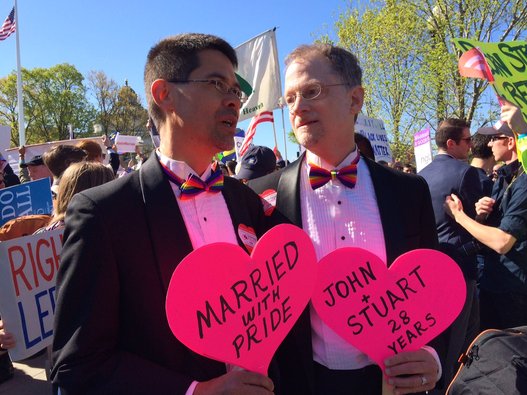
Protestors outside the Supreme Court.
Picture credit: Huffington Post 
The case Obergefell v Hodges was heard by the US Supreme Court earlier this week. This is the case asking the Court to force States to recognise the marriage of gay couples on other states. The couple in question (James Obergefell and John Arthur) went to court to get Ohio to recognise the marriage that took place in Maryland in 2013. John Arthur was terminally ill, and Obergefell wanted the state to recognise him as the spouce and beneficiary of Arthur's estate.

The Economist has a leader here about it - which explains the argument in favour (and also explains the argument againist). There is also an article about  the impact of the current situation, where marriage is legal in one state and not in another (pretty horrendous).

Of interest to G and P students in Unit 4C is the analysis that although it is likely to be an activist decision with Roberts and Kennedy in favour of Obergefell this unlikely to be as controversial as Roe v Wade:

Firstly Americans are increasingly in favour:
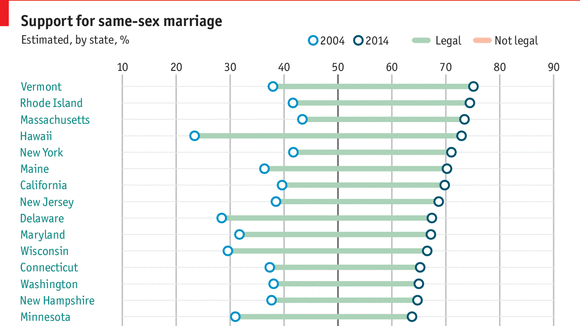
Picture Credit: The Economist


Also, to quote the leader:
the court ruled in Roe v Wade that it should be legal everywhere, citing a right to privacy that is nowhere mentioned in the constitution. This newspaper favours legal abortion, but in Roe the justices invented the law rather than interpreting it, substituting their preferences for those of voters.
The main argument against seems to be that the allowing of gay marriage across America should be left up to elected representatives to pass a law. The counter to that is that if it is not acceptable to practice discrimination of a, say, racist or sexist type under the constitution, it should also not be acceptable to discriminate against gays.

There is a great timeline in the LA times of the change in attitude of the USA to gay marriage here:

A timeline of the USA's support for gay marriage.
Picture Credit: LA Times
The decision is likely to be revealed in June.

Update July 2015: I forgot to update this in the light of the US Supreme Court decision in June, but worthwhile to record here the momentous decision by the Court that prevents Gay Marriage from being banned in States.  The court voted 5-4 with Kennedy siding with the liberal justices.

Wikipedia's page about the case, Obergefell v Hodges can be found here. The Scotus blog's summary can be found here.

The Atlantic tries to put this all into context here with a summary of the long battle for gay rights.
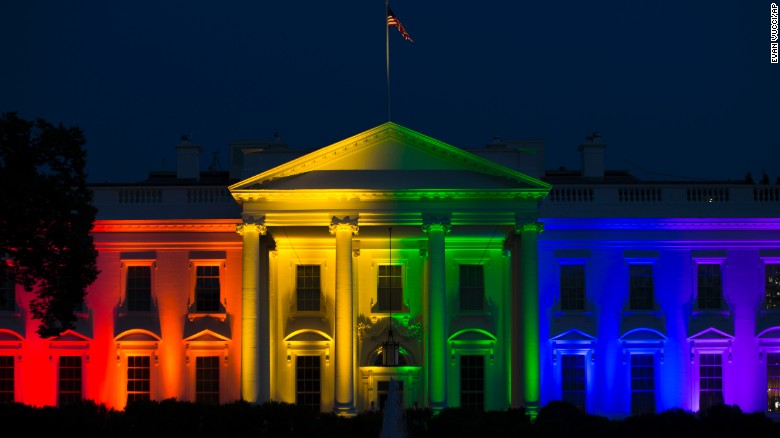
The White House celebrates the US Supreme Court decision.
Picture credit; CNN


Friday, 3 April 2015

Federalism and Indiana's law Religious Freedom - Gay rights

Indiana recently passed SB 101, or the "Religious Freedom Restoration Act", which allows individuals in Indiana to avoid civil rights legislation if they think that their own religious freedom is being "burdened". It has become controversial because it was passed by a Republican-dominated State Congress and has been seen by some, including the head of Apple, Tim Cook, as discriminatory against members of the LGBT community. Stopping discrimination against minority groups is one of the corner stones of Civil Rights legislation.

This is against the background of gay marriage being allowed (or at least not found to be unconstitutional) in the Supreme Court with US v Windsor in 2013, the Hobby Lobby decision of 2014 which allowed corporations to believe in God in order to avoid civil rights laws they don't like, and the rise in the Tea-Party wing of the Republican Party over recent years. 

Republican policy and the problem that this law in Indiana gives to the prospective Republican candidates is examined here in Rolling Stone Magazine (headline in a very aserbic piece: "GOP to LGBT, 'OMG you're still here?' ").

Both the Hobby Lobby case and US v Windsor should be on the list of cases any G and P student discusses in any essay on the Supreme Court and whether it is activist / conservative / liberal. 

The Indiana case is useful because it highlights the different traditions of states in a federal system, and also the policies of the Republican Party (good for Unit 3C). Good analysis here about the law in the Washington Post. There is clearly a clash here between Federal law and State law - one of the jobs the Supreme Court does is to referee arguments about such issues.

The Onion has a great headline which suggests the fix the law has caused for Republicans: "Indiana Governor Insists New Law Has Nothing To Do With Thing It Explicitly Intended To Do".

Tuesday, 7 October 2014

Gay Marriage and Blue Dog Democrat(s)

The US Supreme court has refused to hear appeals from states wanting to ban gay marriage, The Economist sees this as very significant, and Politics students could use this as an indication of where the court stands currently.
A same-sex wedding ceremony.
Picture credit: Marc Love / Wikipedia
essentially meaning that although they won't now be making any sort of decision on it, the lower (Federal) court decisions that saw any ban as unconstitutional will stand.


The Roberts court could have been activist and made a ruling, but it didn't. As the Economist notes there are theories why this is the case - in a politically divided country this would perhaps have made the situation worse. The Guardian sees this as an expansion of gay rights. Helpfully, the Wikipedia page goes into all of this, noting that it is currently legal in 25 states and that many thousands of couples have taken advantage of the new law.

A "conservative" court may find that banning gay marriage at this point would be very tricky.

Elsewhere, the Economist (again) has an interactive map about the mid-term race in the Senate; the short version is that the Republicans may take a 50-48 lead over Democrats with 2 seats being held by Democrat-friendly Independents.


Lastly, the Blue Dog Democrat is almost an extinct species; one of the last conservative Democrat holding a seat in the deep South is fighting a difficult battle in the 2014 House races.

Useful for Unit 3C - Democratic Congressman John Barrow from Georgia is a great example of someone who has kept in the centre while the rest of politics in the US becomes divided.

Tuesday, 31 December 2013

2013 - Review of the Year - USA

Try this from Andrew Sullivan at the Dish - Gay Marriage, Affordable Care Act (ACA - Obamacare), and the prospects for the two main parties.

Sunday, 14 July 2013

Gay marriage, Voting Rights and pressure groups

Briefly, as a follow-on to my previous post about the recent decisions in the Supreme Court, and after the success of the LGBT movement in getting the Supreme Court's decision on gay marriage, there are signs that the movement as a whole is going to focus on overturning the recent decision to nullify part of the Voting Rights Act.

An interesting article here from Rolling Stone Magazine.

Useful pressure group examples might be those mentioned in the article, the snappily-named "Queers for Economic Justice", and "Queer the vote", both of which in various ways are moving on from simply being focused on LGBT issues.

The latter, for example highlights the fact that the community they represent could be significant in an election:

The lesbian, gay, bisexual and transgender (LGBT) vote is sizable and bipartisan, and can be a swing vote in a close election.

Tuesday, 9 July 2013

Supreme Court, Gay Marriage, and voting rights

The Supreme Court's decision about gay marriage in the USA clears the way for gay marriages to take
place. The short version of the story is that the court struck down the 1996 law "Defence of Marriage Act" which banned the practice.

All of which might make any G&P student think that this is a progressive, activist court, establishing new rights in the mode of Roe v Wade or Brown v Board. It is important to notice that there are in fact two related decisions here; the overturning of California's Proposition 8, and the overturning of 1996's DOMA.

Also, it is worth pointing out that the reality is more complex as fundamentally this was not a decision about the constitutionality of gay marriage.

The 2013 decision (US v Windsor) about DOMA arguably is more significant, since the decision says that the federal government cannot discriminate against gay couples. It is not saying that gay marriage is constitutional, but that discriminating against it is not constitutional, and falls foul of the fifth amendment (the "due process" clause). Individual states can pass laws allowing gay marriage (and many have), but it is still up to the states to do so. Many states have laws which discriminate against gay couples.

Importantly, the decision allows same-sex couples to enjoy the same tax-breaks, and benefits that different-sex couples do at a federal level, but does not at a state level (see left for a map of the US states and their opinion about gay marriage over time). A very good analysis from the legal position can be found here at the SCOTUS blog which discusses other related discrimination (so-called "mini-DOMAs").

The decision about Proposition 8 (2013's Hollingsworth v Perry), like the DOMA decision was all about legal procedure, and so did not deal with the constitutionality of the banning of gay marriage under Proposition 8 (a referendum) at all.

A good summary about the US v Windsor decision is here at the Huffington Post, and an interesting analysis of where this puts the Roberts' Supreme Court can be found here (the short version of this article is that Roberts is more conservative than might be seen at first as he is increasingly emphasising the rights of the states at the expense of the federal government).

Interestingly both decisions about gay marriage were passed 5-4, although Windsor saw the Justices split along conservative / liberal lines, and Perry did not.

One of the other recent controversial decisions was 2013's Shelby County v Holder, which saw the justices strike down part of the important civil-rights era Voting Rights Act of 1965. Analysis of that can be found here at the liberal Huffington Post. Again, although the details are very complex, the decision essentially removes some of the protection for minorities and their ability to vote.

[Picture Credits - The New Yorker & The Huffington Post]

Wednesday, 5 June 2013

Republican Party - leaving the young behind?

Rolling Stone Magazine has an article detailing how the Republican party is leaving behind young people, who overwhelmingly supported Obama in the 2012 election. The article discusses a survey done for the Republican Party and published here, which essentially highlights the fact that the GOP's opinion of gay marriage turns off young voters. Abortion as a divisive electoral issue is less important for Americans born after 1980, than it is for older voters.

Probably more useful for Unit 3C than Unit 4C, but could be useful background for any essay contemplating how representative Congress is, or the nature of Presidential power:

President Barack Obama won 5 million more votes than Gov. Mitt Romney among voters under the age of 30 in the 2012 election. Despite Romney holding a 2 million-vote advantage over the President among voters aged 30 and older, Obama’s significant lead with the youth vote was enough to ensure his re-election. While Obama’s advantage among young people shrank from 34 points in the 2008 election to 23 points in 2012, the election reinforced the generational challenge faced by the GOP.

Friday, 10 May 2013

States Rights & the power of the Vice President

I will do a post covering major recent events in American Politics soon, but in the meantime take a look at this Joe Biden interview in Rolling Stone Magazine which discusses his influence and why he is the "last guy in the room" after every meeting with Obama:


A blog post from the Economist magazine discusses the importance of States rights and also a recent law in Texas which seems to underline the rights of state officials to ignore federal law. So, the federal government may pass a law to limit access to guns, but Texas certainly doesn't have to enforce that law:

A quick reminder that the debate about gay marriage has reached the Supreme Court and that some kind of decision over California's Proposition 8 (a popular vote which banned it) is due some point in late May or June. Bloomberg has an article about it here, indicating the decision may not be entirely straightforward. The decision over Obamacare was not straightforward either, although some simplification is sensible for the A2 exam.

Holding handsThe short version of the Obamacare decision is that the law is constitutional, but only if classed as a tax (which the Federal government has the right to levy). The problem for the Obama administration is that Obamacare was not called a tax and in fact they denied that it was.

To finish, there is a great article in the Economist this week which discusses the various methods Obama has used to get round the obstructionist Congress. You can find it here. He has used the control of the executive to ignore certain parts of legislation, announced this using signing statements, and used "recess appointments" to get members of the executive confirmed without Senate approval. Great stuff.

[Picture Credits: Top - Rolling Stone. Middle - The Economist. Bottom - Hoai Phuong, Flickr]

Sunday, 7 August 2011

Gay Marriage

A news item from June highlighted how some of the States are passing into law acts which allow same-sex couples to marry, without the federal government stepping in.


While more and more Americans approve of the idea, it remains a politically sensitive area. Plenty of information on this

page of Wikipedia.

The graph comes from this blog post on the NY Times.

This posting from the Supreme Court blog (not written by the justices I may add) discusses the cases working their way up the judicial system (Perry v. Schwarzenegger & Windsor v. US) and some of the core implications which they raise:

States power, marriage, and religious freedom (as enshrined in the 1st Amendment) to name but 3.

Perhaps most importantly for A2 G&P students is that the piece predicts that the Supreme Court will have to look at the issue because of the important constitutional issues it raises.

Sunday, 29 August 2010

The limits of Presidential power; Gay marriage and the New York Mosque

Some interesting articles about the limits of presidential power, and why they should (or shouldn't depending on your point of view) get involved in complex domestic issues which polarise opinion.

There are two current news stories which relate to this; the first being Gay marriage and Proposition 8 which I have posted about before, and the second being the proposal to build a mosque in New York near the site of the September 11 attacks, Ground Zero.

Essentially there are two arguments about whether Presidents should get involved and show their support one way or the other. President Obama has repeatedly said that he was against gay marriage, but that the way to prevent it should be done through the states and not in an amendment to the constitution. This position has caused an outcry in certain circles, notably this piece on the CBS News web-site:

Obama argues that he is against gay marriage while also opposing efforts like Prop 8 that would ban it. He justifies this by saying that state constitutions should not be used to reduce rights. (His exact words: "I am not in favor of gay marriage, but when you’re playing around with constitutions, just to prohibit somebody who cares about another person, it just seems to me that that is not what America is about.")
.

The Economist's Democracy in America blog, predictably, has a more cautious message; that for a president to come out and support an issue makes that issue instantly politicised and polarised:

But that, of course, is the point: presidents are expected to operate within existing political conditions, not engage in theoretical speculation. What would have been the actual political consequences of a decision by Barack Obama to come out in favour of gay marriage in the past year and a half? I don't think there can be any doubt that such a move would have re-politicised an issue that, remarkably, has become steadily less partisan in recent years.

The second issue which has become a political hot-potato recently is the outrage which has followed the announcement that a mosque was to be built in New York near Ground Zero. Strangely, for a multi-racial and multi-cultural society Americans and their politicians have overwhelmingly come out against the plan. This is, obviously, despite the fact that the attacks on Sept 11th were against thousands of people of all faiths, including Muslims.

President Obama at first seemed to come out in favour of the mosque-building plan, but then seemed to change tack and say that he was not discussing the wisdom of building it, but rather that the Islamic organisation in question had the right to do so. Arguably, this is another case where Obama is being cautious and is trying to avoid making the issue any more partisan than it is already.

I find it interesting, that according to this piece here, New York City has over 100 mosques already, for the 8.4 million inhabitants. According to this poll by the right-leaning Fox News, there is support for the right to build, but not the wisdom (commentary by politics web-site Five-Thirty-eight):

A group of Muslims plans to build a mosque and Islamic cultural center a few blocks from the site of the September 11 terrorist attacks in New York City. Do you think it is appropriate to build a mosque and Islamic center near ground zero, or do you think it would be wrong to do so?
Only 30 percent of respondents said "appropriate", while 64 percent said "wrong" -- consistent with the apparent unpopularity of the mosque in other polls.

But Fox also followed up with this question:
Regardless of whether you think it is appropriate to build a mosque near ground zero, do you think the Muslim group has the right to build a mosque there, or don’t they have that right?

Here, the numbers were nearly reversed: 61 percent of respondents, including 69 percent of independents and 57 percent of Republicans, said the developers had the right to build the mosque; 34 percent said they did not.

New York Times columnist Stephen Budiansky has a great graphic on his blog which summarises the absurdity of the furore in the run-up to the mid-terms very neatly:


Essentially both of the stories above are grounded in the rights of Americans to act as enshrined in the constitution, attempts to curtail those rights, and whether or not presidents should get involved in these key issues.

Interesting stuff for G&P students contemplating the limitations of presidential power.

Tuesday, 17 August 2010

Marriage and the 14th Amendment

In a previous post I wrote about the overturning of California's Proposition 8, which bans gay marriage, by the US District Court. I thought it was interesting to note Schwarzenegger's position in this given that he is socially quite liberal; his name is on the case because he is California's Governor and while he opposes the ban he felt it was an important constitutional issue which needed to be decided in court.

The Democracy in America blog from the Economist has linked to a couple of video clips which show two of the lawyers involved in the overturning of the ban defending their position against the best that the Republican Party can throw at them: Essentially the right to marriage is a fundamental right under the constitution as decided in a number of previous Supreme Court judgements. The 14th Amendment which ensures equal treatment under the law includes the right of all Americans to get married to the person of their choice, irrespective of race or sexual orientation. Fundamental rights are ones which cannot be taken away by the states through laws or through public vote (as happened with Proposition 8):


Interestingly, the Republicans' argument in favour of a ban on gay marriage are shown in both clips to be very weak indeed. The second clip was initially found here.