Contributors

Showing posts with label obamacare. Show all posts

Tuesday, 11 February 2014

Obamacare - Good or Bad for Democrats - analysis

In brief, there was a report by the non-artisan Congressional Budget Office (which analyses government policy and spending) about the impact of the Affordable Care Act (aka Obamacare). In essence the headline is that there is a cost to the economy.
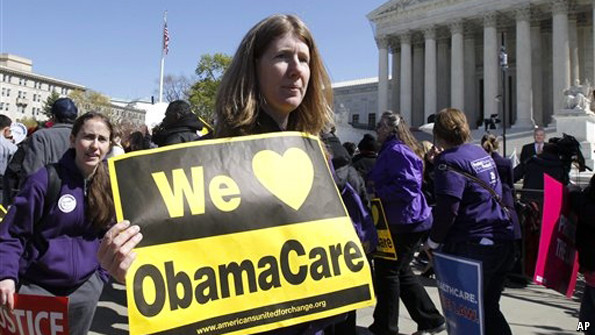
Supporters of Obamacare. Picture Credit: Economist.com

Republicans are now able to claim that Obamacare will cost jobs, and Democrats say that it won't. Analysis about the messages here from Politico.com.

Writers at the Economist are also divided - analysis here saying it is bad (paywall), and analysis here saying it isn't essentially bad for the US economy. The nub of the issue is whether you think it's a good or a bad thing that thanks to the subsidy of Obamacare Americans are able to get more free time for the same money by spending less time at work.

Although the ins and outs of the argument are too detailed for G and P students' requirements and are more appropriate for an economist, it nevertheless does highlight the problem that President Obama has with the policy and its implementation.

Tuesday, 31 December 2013

2013 - Review of the Year - USA

Try this from Andrew Sullivan at the Dish - Gay Marriage, Affordable Care Act (ACA - Obamacare), and the prospects for the two main parties.

Sunday, 29 September 2013

Congress, Government shutdown and Healthcare in USA

There is a possibility that the current budget crisis in the USA will lead to a government shut-down. The Economist has a long piece about it, here (although this may not be available to all). The issue is the Republicans are refusing to sign a new budget for the year ahead with funding for Obamacare. The Democrats are refusing to pay ball and, because both parties control a chamber of Congress, there is gridlock on the issue.

The BBC's Mark Mardell discusses it here.

One of the oddest recent parts of the debate was a 21-hour speech in the Senate by Ted Cruz (R) who was trying to stop a vote. For various technical reasons it was not a filibuster, but is a great example of the genre for G & P students studying Congress for Unit 4C. The highlight (if that's the right word) was the few moments the Senator devoted to reading Dr Seuss's "Green Eggs and Ham".


The BBC has a Q & A about the issue here.

If the issue hasn't been resolved by 1st October, the US government will shut down until a budget is agreed. We'll see what happens.

Friday, 10 May 2013

States Rights & the power of the Vice President

I will do a post covering major recent events in American Politics soon, but in the meantime take a look at this Joe Biden interview in Rolling Stone Magazine which discusses his influence and why he is the "last guy in the room" after every meeting with Obama:


A blog post from the Economist magazine discusses the importance of States rights and also a recent law in Texas which seems to underline the rights of state officials to ignore federal law. So, the federal government may pass a law to limit access to guns, but Texas certainly doesn't have to enforce that law:

A quick reminder that the debate about gay marriage has reached the Supreme Court and that some kind of decision over California's Proposition 8 (a popular vote which banned it) is due some point in late May or June. Bloomberg has an article about it here, indicating the decision may not be entirely straightforward. The decision over Obamacare was not straightforward either, although some simplification is sensible for the A2 exam.

Holding handsThe short version of the Obamacare decision is that the law is constitutional, but only if classed as a tax (which the Federal government has the right to levy). The problem for the Obama administration is that Obamacare was not called a tax and in fact they denied that it was.

To finish, there is a great article in the Economist this week which discusses the various methods Obama has used to get round the obstructionist Congress. You can find it here. He has used the control of the executive to ignore certain parts of legislation, announced this using signing statements, and used "recess appointments" to get members of the executive confirmed without Senate approval. Great stuff.

[Picture Credits: Top - Rolling Stone. Middle - The Economist. Bottom - Hoai Phuong, Flickr]