A blog about politics in the UK and the US designed for students of Edexcel Government and Politics Units 1, 2, 3C & 4C.
Updated irregularly by teachers of History and Politics.
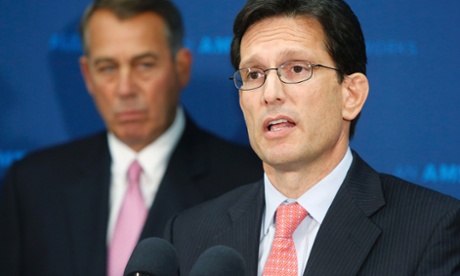
The important point to make is that Cantor was one of the most important Republicans in Congress, and a defeat in a primary election for a politician of his seniority and in his post has never happened before.
For G and P students studying Unit 3C and 4C this is great stuff, as it can be used as an example of how primary elections are in fact the important votes in a majority of US House elections.
The BBC's Mark Mardell has more here; where he discusses how the Tea Party wing are still against any form of compromise, and all that entails. Eric Cantor lost the vote, despite vastly outspending his opponent, an Economics professor called David Bratt.
Important for G and P students as they contemplate the impact on the Republican Party and its policies in the run up to the mid-terms and the start of the 2016 Presidential campaign; will the party lurch more to the right? Unsolicited advice for the Republicans can be found here, in the Huffington Post, and here in Politico.
According to this piece on the political blog The Hill, the primary voting season has shown the power of Sarah Palin, the Tea-Party's first lady and former governor of Alaska, on the political scene. Specifically candidates who she has supported in the run-up to the November mid-terms have been successful, and notably more right-wing than the candidates they beat.
The ins-and-outs of this won't be especially useful for G&P students, except that it'll be interesting to note what happens in November, especially if Obama supporters stay away from the polls.
Of note for anyone contemplating the direction of the Republican party is the news that former political renegade and maverick John McCain kept his seat in Alaska because he supported positions more right-wing, especially on immigration, than he has previously.
Another interesting development is that because of the generally anti-politician feeling in the states, there are politicians attempting to be different. Marco Rubio, a Republican Senate seat nominee is doing this by avoiding the Tea Party and having an actual set of policies he would like to put into practice when in office. The comment by the Economist's Democracy in America blog is pretty scathing about his policies for which the numbers don't add up:
It's true that advancing policy proposals is more courageous than running on facile outrage: having an agenda courts the risk that people will take your agenda apart. Nonetheless, I don't find it convincing to praise Mr Rubio simply for having put forward an agenda. The problem remains that Mr Rubio suffers from a fundamental malady that afflicts the entire tea-party movement. Tea-partiers who believe that the federal government must dramatically cut its budget deficit remain resolutely unwilling to draw the inevitable conclusion: either taxes must go dramatically up, or major, popular federal programmes (defence, Social Security, Medicare) must be dramatically cut. One thing we should have learned from the 2000 elections, and the budgetary debacles that have followed, is that an unwillingness to make the numbers in your proposals add up is a character flaw of the first order.
The other way is being the non-politician's politician and telling anyone who'd listen that you will not doing negative campaigning (i.e. attacking the character and policies of your opponent). For an example of the genre, take a look at the ad by Colorado Democratic-governor candidate John Hickenlooper:
As a rejoinder to that, here is a piece by CBS news about negative campaigning from John McCain in the 2008 presidential race:
All of which is useful stuff for anyone contemplating the impact of pressure groups on parties (or even of factions within parties), elections, and the policies of the Republican party.
More about Republicans and the Tea Party movement from the Blog / independent news outfit "Mother Jones". Former Republican Congressman Bob Inglis was a conservative "firebrand" in the 1990s, was given a 93% rating by the American Conservative Union and became more moderate since re-election in 2004. What is interesting for G&P students is the impact of the Tea Party on his race for re-election and what it means for the Republicans in general.
In short, Inglis lost in the primary election to a Tea-Party approved candidate. His crime was not being prepared to call President Obama a "socialist" and to support some of the more interesting ideas from the Tea Party, and even to propose working with the president:
When he returned to the House in 2005, Inglis, though still a conservative, was more focused on policy solutions than ideological battle. After Obama entered the White House, Inglis worked up a piece of campaign literature—in the form of a cardboard coaster that flipped open—that noted that Republicans should collaborate (not compromise) with Democrats to produce workable policies. "America's looking for solutions, not wedges," it read. He met with almost every member of the House Republican caucus to make his pitch: "What we needed to be is the adults who say absolutely we will work with [the new president]."
Instead, he remarks, his party turned toward demagoguery. Inglis lists the examples: falsely claiming Obama's health care overhaul included "death panels," raising questions about Obama's birthplace, calling the president a socialist, and maintaining that the Community Reinvestment Act was a major factor of the financial meltdown. "CRA," Inglis says, "has been around for decades. How could it suddenly create this problem? You see how that has other things worked into it?" Racism? "Yes," Inglis says.
What happens in the future?
Inglis is a casualty of the tea party-ization of the Republican Party. Given the decisive vote against him in June, it's clear he was wiped out by a political wave that he could do little to thwart. "Emotionally, I should be all right with this," he says. And when he thinks about what lies ahead for his party and GOP House leaders, he can't help but chuckle. With Boehner and others chasing after the tea party, he says, "that's going to be the dog that catches the car." He quickly adds: "And the Democrats, if they go into the minority, are going to have an enjoyable couple of years watching that dog deal with the car it's caught."
Useful stuff for anyone contemplating what the Republican party stands for, and possibly the impact of pressure groups on parties. Also, you can use it to discuss primary elections.