Contributors

Showing posts with label Foreign Policy. Show all posts

Friday, 3 April 2015

Presidential Foreign Policy - Obama and Iran

President Obama's recent negotiations with Iran and the rest of the "P5+1" (US, UK, France, Germany, China and Russia) have come up with a "historic" agreement to stop Iran from building a nuclear bomb. 

Certainly a good example to use when discussing the power of the president and foreign policy; however, there is still much work to be done and this is not actually an agreement as such. It is an agreement to continue working towards an agreement.

Of more use for any G and P student working towards Unit 4C is the idea that Congress can scupper the deal; Israeli Prime Minister Benjamin Netanyahu's speech to Congress essentially went over the head of the President and was an appeal to Congress (or more specifically the Republican-dominated Congress) not to allow Obama to leave Israel weakened.
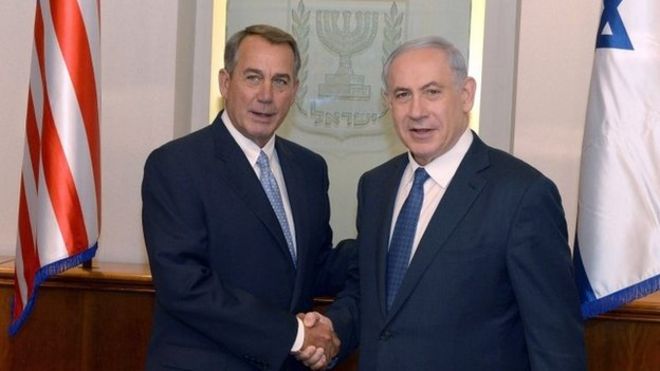
Republican Speaker Boehner & Israeli PM Netanyahu.
Picture Credit: BBC

As a result, the President is likely to find it hard to get any Iran deal through Congress - although there may be technical ways of avoiding or limiting the Republican Party's power, the Senate has the power of "advice and consent" over treaties negotiated by the President.

Further analysis by the NY Times here, Netanyahu's comments about the agreement here, and the BBC analyses the power of Congress here.

Great stuff for any G and P student contemplating Presidential power over foreign policy.

Sunday, 1 September 2013

Syria - UK

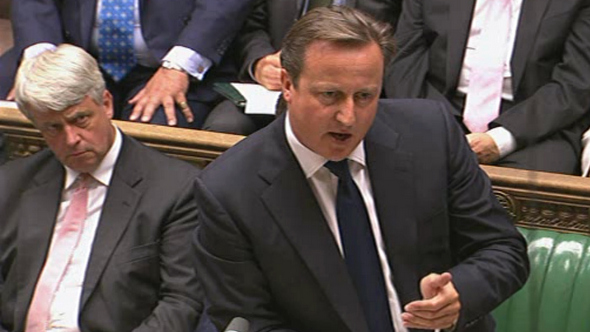
Fascinating stuff is going on in relation to the Syrian crisis, and while there is certainly great human misery there, G & P students should bear in mind the domestic political reaction to these events when contemplating aspects of Unit 1 and Unit 2. In the UK, PM David Cameron recalled Parliament to debate the possibility of taking military action. Parliament does not get recalled very often, and then only in an emergency.

Cameron also wanted permission to send military resources into action - not an invasion, but rather a highly limited bombing of selected targets.

Interestingly, he failed to win the vote, and has ended up with a decision in the House of Commons which has meant (at least in the reading of most commentators) that he will not be able to take any military action at all in Syria.

This is an event without precedent - no PM has lost a vote about foreign policy actions in the modern era. Cameron's ability to act is not severely curtailed, and perhaps this will mean that in future PMs will have a similar restriction on their actions. Is the power of the PM now much weaker? Possibly. A Telegraph report is here, the BBC's Nick Robinson's piece is here, and the Independent discusses it here.

Depending on who you read, there are many different opinions; Cameron certainly seems weaker, but according to the Telegraph, so is the Labour leader Ed Miliband, who was thinking about domestic political advantage rather than about how to help dead Syrians. The normally left-leaning Guardian has a piece which says Miliband was weak too.

The Sun posted an obituary of the "Special Relationship", which I thought was rather funny (sadly I'm not able to show the picture here). There certainly are implications for Britain's status in the world, although this is rather beyond the G & P syllabus.

The Economist's Blighty Blog discusses the whole thing here.

[Picture - The Economist]