The Coalition has released proposals which aim to solve the so-called "West Lothian Question"; or to put it another way, "English Votes for English Laws".
Proposals on how to change the British constitution further have been announced by Commons Leader William Haig. The Coalition released a document which explains the ideas put forward by both parties - fascinatingly, the final part has the different ideas of the two parties in colour-coded sections.
G and P students certainly need to bear in mind that constitutional reform is an important theme of Unit 2 and that current issues, like the Scottish Referendum and the ensuing repercussions should be mentioned.
Showing posts with label Scottish Independence. Show all posts
Showing posts with label Scottish Independence. Show all posts
Saturday, 20 December 2014


Monday, 8 September 2014
Google on the Scottish Referendum
In the days leading up to the Scottish Referendum, Google has launched a page which aggregates video and news feeds about this important issue. Worth having a browse through.
Sunday, 20 July 2014
New events in UK politics over the Summer
Briefly and in no particular order, David Cameron did a cabinet reshuffle which saw some big-hitters such as Education Secretary Michael Gove and Foreign Secretary William Haig losing their jobs. Marginally more women are now in Cabinet than before, and this is certainly an attempt to give the Conservative Party the edge in the lead-up to the 2015 election.
Labour has plans to re-nationalise the rail system (a throw back to Old Labour perhaps?).
The House of Lords has a debate about assisted-dying, although there is no likelihood of it becoming law. This highlights the importance of the Lords in debating issues.
The only woman Muslim in the Cabinet, Baroness Warsi resigns over the government's policy on the fighting in Gaza. A blow for Cameron, and there may be an impact on his policies and his own power. The Economist analyses the resignation here.
As a follow on, Boris Johnson has finally admitted that he is interested in fighting for a seat in the Commons in the 2015 election. If successful, he will be an MP and the London Mayor, at least for a brief period. At the end of August he finally confirmed that he will contest the seat of Uxbridge.
There was a debate about Scottish independence between the Scottish First Minister Alec Salmond and Alistair Darling, former Labour Chancellor. Highlights are below. Both sides have declared victory, although the vote itself will tell the truth. Analysis from the Economist here.
The Independence second debate between Salmond and Darling was interesting; fewer one-liners but Salmond came out on top and by a large margin "won" 71% to 29%. Worth bearing in mind that this "snap" polling is more about performance on the night rather than any change in intension to vote. Great analysis from the BBC's Nick Robinson here. More from the Economist here. Useful stuff for anyone contemplating the importance of referendums and the prospect for constitutional change in the UK. In addition, Cameron has promised more powers to the Scottish Parliament should the vote be "No".
Gov and Pol students contemplating the House of Lords would find recent news useful. Despite the Lords being too full for the facilities, and being the second largest legislative chamber in the world, 22 new peers have been appointed, including TV star Karen Brady. The Lords currently stands at 796 members.
More problems for David Cameron (useful for any student contemplating the Conservative Party's political stance) in the shape of a Tory MP who has defected to UKIP and resigned from his seat. More from Nick Robinson here. The very short version is that it exposes the Tory party as one which is obsessed by the EU and this has all sorts of implications including the rise of UKIP and perhaps increasing the likelihood that Scotland will vote "Yes" in September; the Scots being traditionally more pro-EU.
For no reason perhaps other than a reminder that Jeremy Paxman has been replaced on Newnight by Evan Davis, a brief clip from that esteemed show:
Wednesday, 29 January 2014
Scottish Independence - it's the economy, stupid
In brief, Mark Carney, the Chair of the Bank of England has gone to Scotland to discuss the economic and fiscal issues related to Scottish independence. The SNP would like to remain as part of a club of nations using the Pound as a currency.
The BBC's Robert Peston has a blog post here discussing the problems that this raises; for those G and P students who don't study economics, the short version is that keeping the Pound would limit the benefits of independence for Scotland and also could prove very expensive and economically disastrous.
Quite how this plays in Scotland is uncertain (although a member of the History and Politics dept has his own ideas), but recent polls are showing that the "Yes" camp are gaining ground.
Update (12/2/14): George Osborne will be spelling out clearly that an independent Scotland will not be able to be part of a currency union. Somewhat predictably the SNP are attacking this and calling it "bullying".
Great for G and P students contemplating referendums, the structure of the UK and the power of parliament; as commentator Bill Jamieson says about the issue in the same article, this is probably an issue for the Westminster Parliament, not a Conservative Chancellor.
Apparently, according to Nick Robinson, all three major political parties are lining up to agree that an independent Scotland will not be able to share the pound. A Treasury review by officials is putting more analysis for us all to chew over.
Also - in referendums, people vote with their hearts rather than thinking hard-headedly about the economics of currency union and debt distribution.
Update: 18/2/14: Alex Salmond, the SNP leader and the European Commission President Jose Manuel Barroso have both weighed in.
Salmond has interestingly dismissed the Westminster argument about the currency and said that the cost to the UK of a different currency would be £500 million in transaction costs.
Barroso's contribution is marginally complex but essentially hinges on the problem that other EU states with areas that want independence (Eg Spain) don't want the sight of newly independent countries being given rapid EU membership. This would cause all sorts of domestic issues for them. Barroso essentially said that joining would be "difficult".
Quite where this leads the "Yes" campaign in the referendum is still to be seen. The Telegraph has a blog post which sees these events as fairly catastrophic for the Nationalists (albeit, this paper is very pro-Union)
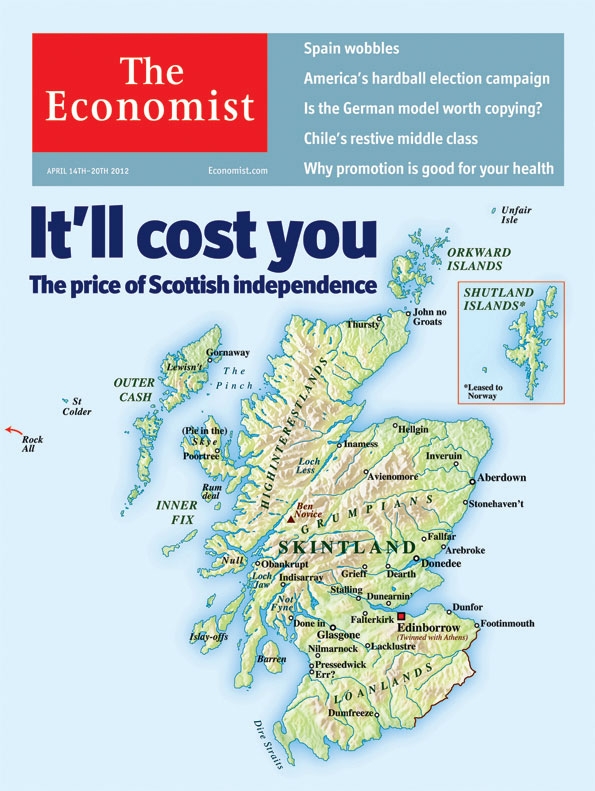 |
| The Economist weighs in. Picture Credit: The Economist Magazine. |
The BBC's Robert Peston has a blog post here discussing the problems that this raises; for those G and P students who don't study economics, the short version is that keeping the Pound would limit the benefits of independence for Scotland and also could prove very expensive and economically disastrous.
Quite how this plays in Scotland is uncertain (although a member of the History and Politics dept has his own ideas), but recent polls are showing that the "Yes" camp are gaining ground.
Update (12/2/14): George Osborne will be spelling out clearly that an independent Scotland will not be able to be part of a currency union. Somewhat predictably the SNP are attacking this and calling it "bullying".
Great for G and P students contemplating referendums, the structure of the UK and the power of parliament; as commentator Bill Jamieson says about the issue in the same article, this is probably an issue for the Westminster Parliament, not a Conservative Chancellor.
Apparently, according to Nick Robinson, all three major political parties are lining up to agree that an independent Scotland will not be able to share the pound. A Treasury review by officials is putting more analysis for us all to chew over.
Also - in referendums, people vote with their hearts rather than thinking hard-headedly about the economics of currency union and debt distribution.
Update: 18/2/14: Alex Salmond, the SNP leader and the European Commission President Jose Manuel Barroso have both weighed in.
Salmond has interestingly dismissed the Westminster argument about the currency and said that the cost to the UK of a different currency would be £500 million in transaction costs.
Barroso's contribution is marginally complex but essentially hinges on the problem that other EU states with areas that want independence (Eg Spain) don't want the sight of newly independent countries being given rapid EU membership. This would cause all sorts of domestic issues for them. Barroso essentially said that joining would be "difficult".
Quite where this leads the "Yes" campaign in the referendum is still to be seen. The Telegraph has a blog post which sees these events as fairly catastrophic for the Nationalists (albeit, this paper is very pro-Union)
Subscribe to:
Posts (Atom)