Contributors

Showing posts with label Labour Party. Show all posts

Thursday, 23 July 2015

Party politics - Labour party in-fighting, and Conservative policies

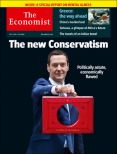
The Economist's take on the 2015 budget:
"Politically astute, economically flawed".
Picture Credit; Economist
The recent Conservative budget (the first Blue budget since 1996) was interesting mainly because it took inspiration from various Labour Party policies ("a living wage") while still sticking to traditional Conservative policies. Main details here, and analysis from the Economist's leader here. There is much to applaud, and also to critique.

However, more interesting is its impact on Labour.

The current Labour leadership battle is fascinating because (apart from anything else) it is a look at the various factions in the Labour Party.

Clearly for G and P students taking Units 1 and 2 in Summer 2016 it'll probably be useful background. By the time the exam takes place there will be a leader in place and there shall be the outline of Labour policy; essential for the "Party Politics" topic of Unit 1.

Despite winning 3 elections and being the most successful Labour leader ever, Tony Blair is despised by some in Labour circles for, principally at least, the Iraq war. His intervention in the Labour Leadership election became controversial, because he warns against Labour "turning left" - in other words becoming "Old Labour" rather than "New Labour".

Which brings us onto the leadership candidates. Details of them can be found here on the Wikipedia page - for our purposes at the moment there is the left-leaning Jeremy Corbyn and the Blairite Liz Kendall, plus Andy Burnham and Yvette Cooper who were part of the previous Labour regime. Stephen Daisley on STV has a great comparison of the different candidates here; most importantly he highlights quite how vicious and unpleasant it has become. For some left-wingers, Liz Kendall is not "Labour" enough and should be a Tory.

At time of writing Corbyn is in the lead prompting Blair's intervention. The battle seems to be between people who want to win elections by formulating policies which the public will vote for, and those who want to remain ideologically "pure".Typical of the genre is this rather unstructured tirade by Bryan Gould in the Guardian:

I have watched in disbelief as Labour leaders have sought to explain their unwillingness to stand firm and fight for what they supposedly believe. We are told that the voters’ support for further victimising those who have been left to pay the price of a recession for which they have no responsibility means that there is nothing further to be done.
“We can’t fight the electorate” is the siren call. But how are the voters likely to view a party that so manifestly lacks the courage of its convictions? Will they not conclude that Labour is fatally short of both courage and convictions?


By contrast here is fascinating analysis from Stephen Daisley; "it's not enough to be right, in politics you have to win too".

One of Daisley's important points is that Labour in the future not only has to win support from voters in England, but also has to win back support in Scotland - the SNP is doing very well and it will be a long battle to get Scotland back. This is a topic for another day:
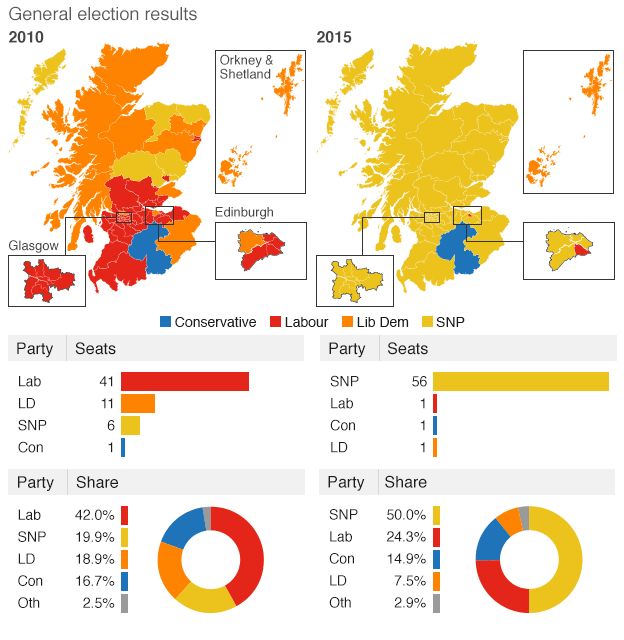
2015 Scottish General election result compared to 2010.
Picture credit; BBC.

Saturday, 4 April 2015

The Leaders' debate, the electoral system, and the party system.

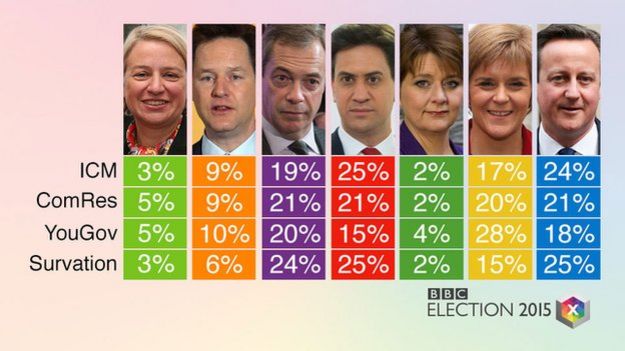
I'm not sure it tells us anything about the result, but the Leaders' debates served to show that the UK is really a multi-party system. Somewhat predictably, comments by Nigel Farage were later criticised. Snap polls after the debate show that the result is still close:

Picture Credit: BBC

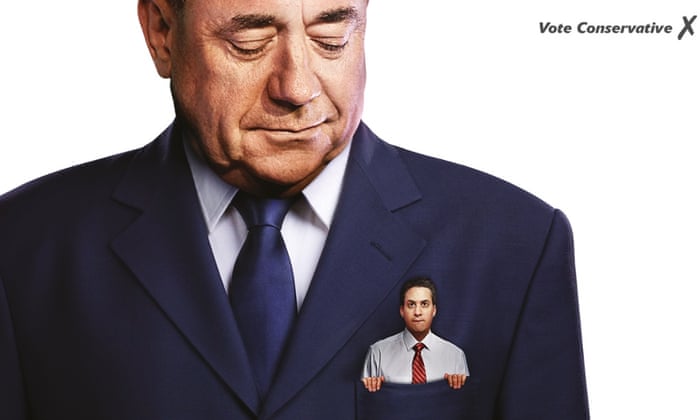
Picture credit: Conservatives / The Guardian

Perhaps most crucially 3 of these "minor" parties are now led by women.

In addition, it is no longer a 3-way battle for influence, the debate showed us that in the UK there are many parties which are claiming with some truthfulness that they represent a large portion of the population. As a result, the FPTP system is arguably now inadequate to the task of electing a stable government which can run Britain.

The likelihood of a major portion of the population feeling disenfranchised and left out is a real risk (imagine the effect on England of an SNP-Labour alliance in Westminster for instance). The Economist has a piece here which analyses the debate and reflects on the influence of the SNP.

SNP reply to Conservative poster. Credit: SNP / Herald Scotland
Analysis about the debate can be found here from the BBC, here from the Independent (which notes that the SNP's Nicola Sturgeon increased her support as a direct result of the debate), and the body-language is analysed here in the Guardian.

The Spectator analyses Cameron's prospects here (he did OK and didn't lose as badly as Miliband).

The Economist has a piece here about what the prospects are for Britain in the future (the TLDR summary is "not great").

For a bit of light relief, have a look at Buzzfeed's collection of the best jokes (eg. comparing the debate to a bad edition of "Take Me Out").

The whole thing can be watched here:


Or highlights can be found here:

Saturday, 28 February 2015

Conservative Party and devolution. Labour and tuition fees

Two headline-grabbing political policies from the two main parties:

Conservatives


Cameron promises to give the Welsh Assembly more powers, including being able to call itself a Parliament and being able to raise its own income tax. Interesting for G and P students in unit 1 considering how Cameron has changed the Conservative party since the days of Thatcherite concentration of power in Westminster.

Labour


Miliband promises to lower tuition fees for University students to £6k from its current £9k. Again - interesting to consider how this fits into the narrative about the Labour party and its move away from / back towards more left-leaning policies.

The BBC's Robert Peston analyses the fiscal implications of all of this here.


Friday, 26 December 2014

Labour and Scotland - party differences?

A post on the BBC blog from Mark Mardell is fascinating for many reasons; for G and P students studying Unit 1, especially significant since it discusses the implication of devolution on party policy. The party has elected a former Blairite to be the leader of Labour in Scotland.

To be specific, the Labour Party in Scotland is likely to be more "left-leaning" than the party in Westminster as Scotland itself is on average (Mardell argues) more left-leaning than England is on average.

There are implications for the Labour party in the 2015 election; if it loses enough of its Scottish Westminster seats to the SNP as currently seems likely, then it will not be able to win power at Westminster. I posted about this earlier in the year:

Picture Credit: UK Polling Report
The implications for party policy across the UK is potentially significant, with parties increasingly having their own national policies better suited to local issues. This may in turn help lead to a more federal UK.

However, Labour is the only party which has (had?) a large established following in Scotland, closely followed by the Lib Dems. The Conservative Party has little power in Scotland, or much of Wales. Therefore, how the Labour Party deals with these issues over the next few years is potentially very important for the rest of the UK and its political parties.

This is also probably an issue worth bringing up in any question about party policy / traditions and devolution.

Monday, 10 November 2014

Voting and Labour in 2015

I came across a fascinating blog by the Economist which led me to this page by YouGov's Anthony Wells; it analyses the voting habits by the public since 2012, and crucially indicates how their habits change over time.

For Ed Miliband the Labour leader, there are many problems - but perhaps the main one is that people who had supported Labour are moving their support to the SNP, UKIP and Green.

Look at for example, 2012:

Movement of voters. Picture credit: UK Polling Report

and compare it to 2014:

Movement of voters. Picture credit: UK Polling Report
Great for any G and P student wondering about party support in the next election, and also about the similarities / differences between political parties and their ideas.

Although the Conservative party are clearly losing out to UKIP, they are essentially stable because of the voters who used to vote Conservative and said they would not vote are turning instead to UKIP.


Thursday, 8 May 2014

UK Political Parties - ideologies over time

While looking for something else I've come across a great site which goes into political ideologies of the UK parties (great for anyone revising / studying the topic for Unit 1).

Rather than simply use the traditional left-right division, the site adds in measure of authoritarianism vs libertarianism.

Here is a great page which shows how the 3 main parties have changed ideologies over time and in different elections.

Political Parties and their ideologies.
Picture credit: The Political Compass 
There is also a test you can take to find out how you fit into this chart; are you more like Ghandi or Stalin?

Perhaps for a bit of light relief, it is worth-while watching Nick Clegg saying "Sorry" for misleading the electorate about student fees before the 2010 election. This time, someone made him sing via autotune:


Wednesday, 12 February 2014

Labour Party policy

A blog post at the Economist web-site has an interesting take on Ed Miliband's political direction for the Labour Party; it notes that if successful in the 2015 election a Labour government would have a very tight limit on government spending.

Ed Miliband's policy outline seems to be (if the Economist is right) to be more power devolved to cities and Mayors, with less concentrated at Westminster. This is despite the failure of the Coalition's mayoral referendum policy in 2012.

The other theme of the Miliband policy outline seems to be a more interventionist industrial policy (i.e. control of big business) similar to the headline-grabbing proposal to limit the prices that the energy companies can charge.

In the current economic climate the public seem to be more in favour of this kind of thing than they were in previous years.

On another note, some wag at Labour party HQ has taken inspiration from Facebook's "look back" feature, and done one for David Cameron and the coalition government:


Tuesday, 17 December 2013

New political alignments in the UK? The death of Party politics as we know it... Jim.

A "fantasy Westminster", with a 1904 proposed design
for an Imperial Hall. Photo credit: NGCA 
I've just come across a fascinating piece in the Economist by the Bagehot columnist about the nature of party politics in the UK; very useful for any G & P student contemplating the nature of the UK's political parties, factions in parties and participation in politics. 

In essence, the piece describes the current three main political parties as "crumbling". It refers to the changing political alignment of society; party politics as we know it today does not represent the different parts of society.

For example, there is a segment of the working class who have some sympathy with policies from both Conservative and Labour:

 But such voters transcend the right/left and big-state/small-state divide. They dislike out-of-work welfare and are socially conservative, but approve of interventionist, and potentially expensive, industrial and housing policies, so are by no means "economically conservative". They could potentially join a coalition on the left, or one on the right.

In turn the piece critiques work by Conservative blogger Tim Montgomerie in the Times (paywall) who suggested some new alignments.

All of which may suggest yet another reason why participation in party politics is declining - the parties as they exist today are unable to represent the different views of society effectively.

An earlier piece by the same blogger in the Economist, drawing on the experience of Europe, suggested these new parties, and I think it is worth quoting in full:

Christian Democrats (c.30% support)
  • Core agenda: Pro-business, institutional conservatism, support for families
  • Voters: Middle- and upper-classes in suburban and rural areas
  • Would draw on: Conservatives, Lib Dems
  • Foreign corollaries: CDU (Germany), Moderates (Sweden)
  • Possible leaders: David Cameron, Ken Clarke, Jesse Norman
Social Democratic Party (c.30% support)
  • Core agenda: Progressive taxation, industrial activism, vocational training
  • Voters: Working- and middle-classes in urban and suburban areas
  • Would draw on: Labour, Lib Dems
  • Foreign corollaries: SPD (Germany), Social Democrats (Sweden), NDP (Canada)
  • Possible leaders: Ed Miliband, Andrew Adonis, Vince Cable
Free Liberals (c.15% support)
  • Core agenda: Cutting taxes, pro-immigration, social liberalism
  • Voters: Younger, urban, middle- and upper-class voters
  • Would draw on: Lib Dems, Conservatives, Labour
  • Foreign corollaries: FDP (Germany), VVD (Netherlands)
  • Possible leaders: George Osborne, Nick Clegg, Peter Mandelson
People's Party (c.15% support)
  •  Core agenda: Living costs, curbing immigration, social conservatism
  • Voters: Older working- and lower-middle-class voters in post-industrial areas
  • Would draw on: Labour, Conservatives, UKIP
  • Foreign corollaries: Die Linke (Germany), Socialist People's Party (Denmark)
  • Possible leaders: Jon Cruddas, Robert Halfon
National Party (c.10% support)
  • Core agenda: Socially conservative, small-state, anti-immigration
  • Voters: Older middle-class and upper-class voters
  • Would draw on: Conservative Party, UKIP
  • Foreign corollaries: True Finns (Finland), Lega Nord (Italy)
  • Possible leaders: Nigel Farage, Liam Fox 
 

Sunday, 18 August 2013

Political Party Size & Pressure Groups

In brief, according to the Daily Telegraph, the number of registered members of the Conservative Party have fallen significantly to under 100,000, and according to the Conservative Home web-site, this is 58,000. This figure is the lowest since WW2.

By contrast, Labour has gone from 156,000 to 188,000 between 2009 and today.

Neither figures are great for the two big parties in UK politics, and this ties in nicely with a key issue that is dealt with in Unit 1; partisan dealignment and the fall in participation in politics.

Pressure Groups

Also, while I am thinking about it, the anti-Fracking protests in Sussex over the Summer are great examples of Pressure Group action. Students studying Unit 1 should certainly be thinking of using events like these in their essays.

[Picture credit - BBC News]

Tuesday, 9 July 2013

Labour and the Unions

Briefly, there is a row over the Labour Party's candidate in Falkirk and how much influence the Unions have over this candidate's selection. It of course raises issues for the Labour Party about its links with the unions.

Of interest to G&P students contemplating the political ideas and beliefs of the Labour party (the Unite Union would like the party to be more socialist), and how candidates are selected by the local parties.

Ed Miliband's solution seems to be reducing the link between the members of a union and them being given Labour Party membership.

Clearly there is an issue here about political participation, and the effectiveness of Britain's political system in a situation where there is a falling membership of political parties.

As ever, the BBC's Nick Robinson has some interesting stuff to say about the whole thing here.

[Picture Credit - BBC News]

Saturday, 4 September 2010

Labour leadership race

I haven't posted about the Labour leadership race since it will be resolved and a new leader installed by the time AS students take their exams in summer 2011. However, I though it was worth noting an article by The Economist's Bagehot.

Essentially, the race is between the two brothers MiliE and MiliD who have been portrayed as miles apart in political terms (David as a Blairite, Ed as a Brownite). Bagehot commented:

The press is full of commentary about British politics that would have you believe that the political landscape echoes to the metallic din of ideological combat. Yet when you look carefully at what the politicians from the largest parties are saying, none of it seems so very far from the centre-ground.

Take the Labour leadership race, which by common consent revolves around the two Miliband brothers. According to the newspaper narrative, Ed Miliband, the younger brother and former cabinet minister in charge of climate change, is significantly to the left of David Miliband, the elder brother and former foreign secretary. I have seen the word Bennite bandied around, in homage to Tony Benn, the former Labour cabinet minister who really was a proper lefty in his day, advocating capital controls and the wholesale nationalisation of British industry. It is true that the pair have been sending little hints and signals since the contest became a two horse race, indicating that MiliE is to the left of MiliD (as some call them) and is more tempted than MiliD by some form of core vote strategy to woo back disaffected Labour voters and former Liberal Democrat voters who are disgruntled by the Con-Lib coalition. But Bennite? Come off it.

Quite who the eventual leader will be should prove interesting, especially as Labour and the leadership contenders have a large problem: The credit crunch and the resulting recession was undoubtedly caused by a failure of the banking system ("market forces"), but there is an argument to be had that there was also a failure of government regulation.

The same government which was lead by Blair and Brown and had Milibands E. and D. as well as Balls E. in major positions in the Cabinet. It is therefore in their interests as prospective leaders of the opposition, as well as potential Prime Ministers if the coalition doesn't last the full term, to say that "it wasn't anything to do with us guv". This also ties neatly into the anti-big-business instincts of the average Labour Party member.

The argument about why the credit crunch happened will run and run, and is also outside the remit of this blog. However, a brief taste of some very technical arguments can be found here and here in the Democracy in America blog. Admittedly these are about the US-side, but the credit crunch was a global event closely linked to the American situation and these postings have some pertinent things to say about the UK.

All useful stuff for anyone contemplating the direction of the Labour Party and that classic exam question "Has the Labour party abandoned socialism?"

As a side note, Robert Peston has some interesting things to say about party funding; essentially Labour is heavily reliant on a small number of very wealthy individuals and Trades Unions, and the Conservatives still rely on the City of London's firms for their party funds. This obviously brings up the question of how much these funds determine the direction of party activity and policy formation.

Tony Blair's memoirs are analysed in many places, including here in the Guardian and here and here in the Economist, which has a comment about the nature of politicians who chase voters:

...At best, progressive politicians can hope to define themselves by fixed values, such as concern for the poorest at home and abroad, rather than by policies with fixed party labels.

This is quite a comforting analysis, of course, if you happen to be a former party leader who bet big that likeability trumped traditional party boundaries. But it is possible to find Mr Blair self-serving yet his description of how real voters think and act convincing. In pursuit of governments which speak to their instincts, lots of people may switch from party to party, while feeling they are being perfectly consistent.

There is a pointed lesson here for Labour members as they choose a new leader this month. They need to decide whether they are choosing a new boss for their party, or one who could plausibly belong to the country as a whole, as a future prime minister. Mr Blair has not endorsed a candidate (probably to the relief of all concerned). But then again he barely needs to. Like customers, voters are always right in his world: that is who he is.

To close, that picture of David Miliband which will follow him to his grave:

Friday, 16 April 2010

I agree with Nick... I agree with Nick

The general consensus is that Nick Clegg had a very good debate with Brown and Cameron for example, here and here - there is a debate to be had about how expectations can lead to a result (expectations of Clegg were by and large low so when he had a better debate than Cameron, who has been perceived as a great orator and debator, then he is the winner), or how the debate itself was hampered by a highly restrictive set of rules.

Overall, I think Clegg played the "I'm not the same as the other guys" line well. Cameron was good, but was hindered by over-cautiousness (being so concerned about making sure that he did not make a blunder that he lost most of his spontaneity and verve). Brown couldn't stop fidgeting, sounded too much like a bureacrat, and did not make eye-contact with the audience or the viewer. Better than expected then - as a result, he has been seen in some quarters as having a very good evening.

The key reason for bringing this all up is that it is unclear what impact these debates will have on the election. There is the possibility that a swing to the Lib-Dems (assuming nothing changes between now and the election - a very unlikely scenario) will impact key marginal constituencies which are Lib-Tory, but will have an uncertain effect on Lab-Lib marginals. Everything else being equal, left-leaning pro-LibDem voters will put their tick in the box of whichever party will keep out the Tories.

Brown's shameless wooing of Clegg on prime-time TV shows how concerned he is by the prospect of a hung parliament to encourage LibDem voters to help Labour by ganging up on the Conservatives. It also reminds us of how close the two parties are in many ways given their history, and recent policies (see my previous post for links).

In terms of G&P students, all useful stuff for any question asking about how minor parties can increase their support / vote / profile (go on the TV in prime-time debating with the leaders of the two biggest parties and do well).

Don't forget, of course, there are the other national TV debates too, in which the multi-party systems of the Welsh Assembly and the Scottish Parliament get to face up against eachother. Again, more publicity and coverage (not to mention equal billing) for smaller and minor parties.

Nor should I ignore the BNP's invitation to appear on Question Time earlier in the year - as a result of a seat in the European elections they have become a party representing a constituency so their ideas should be tested in a public forum. Again - a minor party gains a seat that in turn helps to increase their profile, which may lead to more votes.

That's not to ignore the very serious possibility that the BNP benefited in the European elections from an anti-politics mood among voters in the UK. In this election this mood is likely to benefit UKIP too, that is if Nick Clegg can't be the anti-politician politician.

Wednesday, 14 April 2010

Pressure Groups UK

While I remember, I'll link to this; Labour is creating a standalone Pressure Group which focuses on saving "SureStart" the government policy which supports young families. Although it looks like a Pressure Group it has links to the Labour Party. The idea is to encourage families who would not have voted Labour to get involved in the Labour campaign other ways. Not only is there a web-site, but there is also a Facebook page.

Useful for any question which asks about why Pressure Groups and parties are sometimes difficult to distinguish.

Another recent example which would be useful is the Joanna Lumley - Gurkha Justice Campaign; a fine example of a smart group using its celebrity "face" well (not only did she appear on the radio and TV, but she negotiated with the unfortunate minister Phil Woolas in front of the media). Very Savvy. I wouldn't be surprised if she is made a Dame sometime soon.

MumsNet has got lots of attention recently especially from politicians like David Cameron. The BBC's coverage of the event is here, and the transcript of his interview is here. Gordon Brown's praise of MumsNet, where he shows it has a significant political clout, can be found here, and his interview with MumsNet can be found here.

Tuesday, 13 April 2010

On Labour and Conservative: Manifestos

Not a Spanish dish, but finally the parties' manifestos are out; the Labour one here, and the Conservative one here. Stephanie Flanders has a very interesting post analysing the financial implication of the promises, and works out (amongst other things) that the difference between Labour and Conservative pledges on financial matters are £7bn by 2015-16, which amounts to 1% of GDP. Essentially neither party are being open about their plans for government spending and taxation after the election. Flanders makes the very obvious point that an opposition without access to the government machinery would not be expected to give the answer the party sitting in power with access to the full resources of the Treasury won't give.

Bagehot in the Economist compares the two main parties' manifestos here.

Either way, the difference between the two on this matter is more style than substance - until fairly recently, Brown's attack on the Conservatives has been that they were going to "cut" while Labour "invested". Now Brown's approach is to say that the Conservatives would hurt the recovery, while Labour would protect it (he doesn't say how he'd do this). Conservatives have been claiming that Brown has served Britain badly in the recession (funny how politicians claim that an economy in a boom is all thanks to them, while an economy in recession is someone else's fault, guv. I seem to remember that Norman Lamont, a previous Tory chancellor, saying the same thing during the recession of the early 90s).

Any answer to the AS questions about political parties (there is likely to be a "b" and "c" question about the Labour party and its traditions vs "new" Labour, and one about the Conservative party and Thatcher vs Cameron) should mention the election and some of the current strands. I would consider it highly unlikely to achieve a high mark without mentioning this crucial event.

I cannot claim that the following will be an exhaustive account of the competing ideas of the parties. In no particular order, the Labour party is a left of centre political party, with traditions of socialism, although it is moderate and has moved away from the extreme ideas evidenced with the 1983 Manifesto ("the longest suicide note in History"), and in the "Militant" tendency of the Labour-dominated Liverpool council of the 1980s. See here for a short news item about Labour expelling militant from its ranks in 1985. I can't find the extraordinary clip of Neil Kinnock speaking at that year's conference, but if I do I'll post a link:


Labour moved away from the 1970s policies of high taxation and high government spending (see for example the policies of the Labour Chancellor Denis Healey). High taxation and the calling in of the International Monetary Fund to save the country from bankruptcy lead to Labour's critics for years portraying them as unable to run the economy well. The traditional Conservative Party criticism for years was that Labour was the party of "Tax and Spend".

New Labour under Blair and Brown benefited from the collapse of trust in the Conservative Party's stewardship of the British economy thanks to the exit from the ERM. In addition, they both attracted the support of business (as mentioned in this post by the BBC's Robert Peston), and promised at successive elections not to increase Income Tax. In addition, "new" Labour promised to increase spending on Public services starved of funds under previous Conservative administrations, while using market mechanisms to promote efficiency.

It is not without irony that Brown has seemingly managed to loose the support of business leaders, and his belief in the power of markets to promote efficiency and good practice (for example in the dropping of Royal Mail privatisation from their Manifesto). In addition, Brown and Darling have decided to raise the top rate of Income tax in the recent Budget. Robert Peston has said that in some ways it is the end of "new" Labour, with the party reverting to type, with the country's finances in a very bad way and a Labour government increasing taxes (Stephanie Flanders has said here in her analysis of the Labour Manifesto that the IFS notes since 1997 Labour has increased net taxes for families).

Health care policy has changed in recent years too - under Blair, spending was increased and targets were introduced. A certain amount of market-orientated reform was introduced. Current policy on health is to increase central control by introducing Rights to the NHS which give patients the right to a certain degree of service.
However, it is still a moderate, left-of-centre party who are trying to appeal to middle-class swing voters who supported them in droves in 1997. Plenty of detail here for any relevant question, hopefully, and that's without mentioning "education, education, education", "tough of crime, tough on the causes of crime" and the change to Clause 4.

More soon on the Conservatives in a similar vein. Let me know if I have missed anything significant.