Contributors

Showing posts with label Lib Dem. Show all posts

Saturday, 7 June 2014

UKIP - a contender for power?

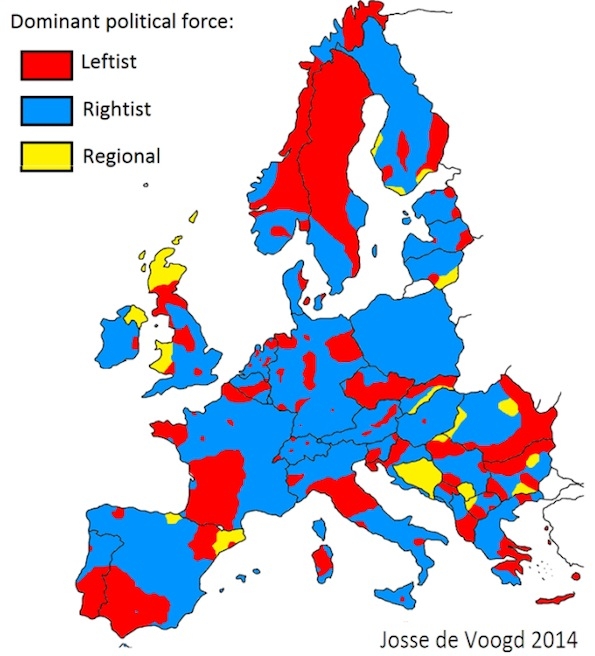
Well, the short answer is clearly "no"; we will not see a UKIP government any time soon. However, they did very well in both the Local Council elections, and the European elections in May 2014. The results of the EU vote in the UK reflect results across Europe with anti-european parties being very popular.
Picture Credit: The Economist.

In the EU elections, they came first with over 4 million votes, which is the first time that neither the Conservatives or Labour have won an election. Analysis here from the Economist's "Blighty blog".

Results can be found on the links above. Nick Robinson has some interesting things to say about UKIP; it can be argued that UKIP has a big support, but EU elections results do not equate to general election results. The Telegraph's columnist has this - essentially, the election is a loss for all parties (as a side note, he also blames things like the colapse of the support for the main political parties).

As G and P students will know, FPTP means that it is very difficult for Farage and co to get seats in the Commons, although former leader Lord Pearson is demanding more seats for the party in the Lords.

There was a by-election in Newark, which went with the Conservatives, but with a reduced majority against UKIP. Somewhat predicably, the Telegraph sees it as a sign the Conservatives will win in 2015.

All of which is useful for any G and P student of Unit 1 contemplating the importance of minor parties in the UK system, and especially whether we are a 2 or 3 or 4 party country.

Also significant is the impact all this is having the traditional 3rd party, the Lib Dems; generally their performance in these elections has been dismal. There are calls for Nick Clegg to go, and even a botched attempt to force him out in favour of Vince Cable. The main problem is that the Lib Dems have been the traditional party of protest, and in government they just can't fulfil that role.

Elsewhere, the Telegraph's columnist blamed politicians who don't sound like human beings, but are obsessed by staying on message. The outcome is that the public don't trust them, or ultimately vote for them. Again - this is a familiar theme in Unit 1.

Thursday, 8 May 2014

UK Political Parties - ideologies over time

While looking for something else I've come across a great site which goes into political ideologies of the UK parties (great for anyone revising / studying the topic for Unit 1).

Rather than simply use the traditional left-right division, the site adds in measure of authoritarianism vs libertarianism.

Here is a great page which shows how the 3 main parties have changed ideologies over time and in different elections.

Political Parties and their ideologies.
Picture credit: The Political Compass 
There is also a test you can take to find out how you fit into this chart; are you more like Ghandi or Stalin?

Perhaps for a bit of light relief, it is worth-while watching Nick Clegg saying "Sorry" for misleading the electorate about student fees before the 2010 election. This time, someone made him sing via autotune:


Wednesday, 22 January 2014

Lib Dem organisation - how effective can they be?

In brief, there is a current news story about Lib Dem Chief Executive Lord Rennard who was accused of sexually harassing women, a claim he denies. The Lib Dem leadership have suspended the party whip for the Lord (who helped them gain electoral success and power in Government) .

The details of the case are complex, as are the nature of the investigation that followed; further details can be found here.

What is more useful for G & P students is this blog post from Nick Robinson who probes the way that the Lib Dem party is run - it is very complex and this complexity has limited the leadership's ability to act:

The Lib Dem party organisation. Photo credit: BBC
Full size version here.

Tuesday, 31 December 2013

Tuesday, 17 December 2013

New political alignments in the UK? The death of Party politics as we know it... Jim.

A "fantasy Westminster", with a 1904 proposed design
for an Imperial Hall. Photo credit: NGCA 
I've just come across a fascinating piece in the Economist by the Bagehot columnist about the nature of party politics in the UK; very useful for any G & P student contemplating the nature of the UK's political parties, factions in parties and participation in politics. 

In essence, the piece describes the current three main political parties as "crumbling". It refers to the changing political alignment of society; party politics as we know it today does not represent the different parts of society.

For example, there is a segment of the working class who have some sympathy with policies from both Conservative and Labour:

 But such voters transcend the right/left and big-state/small-state divide. They dislike out-of-work welfare and are socially conservative, but approve of interventionist, and potentially expensive, industrial and housing policies, so are by no means "economically conservative". They could potentially join a coalition on the left, or one on the right.

In turn the piece critiques work by Conservative blogger Tim Montgomerie in the Times (paywall) who suggested some new alignments.

All of which may suggest yet another reason why participation in party politics is declining - the parties as they exist today are unable to represent the different views of society effectively.

An earlier piece by the same blogger in the Economist, drawing on the experience of Europe, suggested these new parties, and I think it is worth quoting in full:

Christian Democrats (c.30% support)
  • Core agenda: Pro-business, institutional conservatism, support for families
  • Voters: Middle- and upper-classes in suburban and rural areas
  • Would draw on: Conservatives, Lib Dems
  • Foreign corollaries: CDU (Germany), Moderates (Sweden)
  • Possible leaders: David Cameron, Ken Clarke, Jesse Norman
Social Democratic Party (c.30% support)
  • Core agenda: Progressive taxation, industrial activism, vocational training
  • Voters: Working- and middle-classes in urban and suburban areas
  • Would draw on: Labour, Lib Dems
  • Foreign corollaries: SPD (Germany), Social Democrats (Sweden), NDP (Canada)
  • Possible leaders: Ed Miliband, Andrew Adonis, Vince Cable
Free Liberals (c.15% support)
  • Core agenda: Cutting taxes, pro-immigration, social liberalism
  • Voters: Younger, urban, middle- and upper-class voters
  • Would draw on: Lib Dems, Conservatives, Labour
  • Foreign corollaries: FDP (Germany), VVD (Netherlands)
  • Possible leaders: George Osborne, Nick Clegg, Peter Mandelson
People's Party (c.15% support)
  •  Core agenda: Living costs, curbing immigration, social conservatism
  • Voters: Older working- and lower-middle-class voters in post-industrial areas
  • Would draw on: Labour, Conservatives, UKIP
  • Foreign corollaries: Die Linke (Germany), Socialist People's Party (Denmark)
  • Possible leaders: Jon Cruddas, Robert Halfon
National Party (c.10% support)
  • Core agenda: Socially conservative, small-state, anti-immigration
  • Voters: Older middle-class and upper-class voters
  • Would draw on: Conservative Party, UKIP
  • Foreign corollaries: True Finns (Finland), Lega Nord (Italy)
  • Possible leaders: Nigel Farage, Liam Fox 
 

Saturday, 15 January 2011

What is the left for if it isn't for spending money?

Labour leader Ed Miliband has at last explained briefly what he stands for - it is somewhere between Blairist use of the market to ensure efficiency and produce centrally-driven public service reforms, and traditional left-wing big government initiatives to produce a "rebalanced" economy.

He has of course made a little headway with the Labour vote increasing slightly after the recent by-election in Oldham:


The Lib Dems didn't do too badly - while their vote did slip, they are in government and traditionally parties in government do badly in by-elections. That's not forgetting the issue of cuts which the Government is inflicting on the nation.

This item on the BBC web-site highlights the desire for MiliE to appeal to disaffected Lib Dem voters (how dare the party of liberal idealism actually have to make difficult choices while in government and actually, well, govern!). Interesting for G&P students in the way that MiliE tries to cast the choice that the Lib Dems made last may in going into Coalition as a "tragic mistake" - personally I don't think they had a realistic alternative. A Lib Dem-Labour coalition would have been weak and would have fallen quickly ("a coalition of the loosers"). It would not have had the necessary seats in the House of Commons to demand a majority.

This post from the BBC's Nick Robinson has some very pertinent things to say about the way that MiliE's thinking is going:

My sense is that Ed Miliband's speech is made up of the things he instinctively believes and those bits of political positioning he's been advised to adopt. His own views are interesting. At one point he argues: "We can't build economic efficiency or social justice simply in the way we have tried before. It won't be enough to rely on a deregulated market economy providing the tax revenues for redistribution. New Labour's critical insight in the 1990s and 2000s was that we needed to be stewards of a successful market economy to make possible social justice through redistribution. The critical insight of Labour in my generation is that both wealth creation and social justice need to be built into the way our economy works."
By this he says he means a high wage economy, the introduction of a Living Wage and respect for communities so that their concerns about government targets, out-of-town supermarkets and post office closures are not simply ignored in the name of efficiency. What he does not say is how this rebalanced economy - something which, incidentally, I have heard both George Osborne and Vince Cable call for - can be created. Watching how his thinking develops will be fascinating.
Ed Miliband does not yet have a convincing narrative which excuses the previous government for its mistakes and flagrant dishonesty with the obvious truth. Nor yet does he have a clear indication (beyond warm words) of where he will be taking his party, and how he can put Labour-friendly policies into action without any money to spend as previous Labour governments have done:

Ed Miliband needs not only to provide a credible alternative to the coalition's policy of cuts and "Maoist" public service reforms. He needs to explain what social democratic politics looks like in an era without easy money to spend. To do so he may need to develop an account of Labour's period in office that addresses more than just a failure to regulate the banks and a slowness of language. 


The Coalition has raised all sorts of  questions over how parties approach issues and probes the way that party allegiances are currently mapped out. It wouldn't be beyond possibility that the dissatisfied Lib Dem supporters (former SDP / Labour members) would return to the Old party fold. The trouble is, that while it's all very well to be idealistic and to promise not to raise University Tuition fees (as the Lib Dems did before the election) when you are not expecting to have to go along with any promise you make.

The Lib Dems have for years been the posturing opposition to business as usual. When thrust into Government, tough choices have to be made, especially at a time when there are significant questions over government debt. Any party not prepared to govern is merely a Pressure Group.

Friday, 16 July 2010

Coalition policies - progressive or conservative in disguise?

The new Lib-Con coalition government has produced some thought-provoking new policies. Overall, they seem progressive and more liberal in a classical sense than conservative, and are going ahead with these policies at a time of major government spending cuts. Labour claims that the cuts are the "same old Tory" cuts which are what they would have done anyway because that is what Tories have always done.

The key problems for Labour are:

1. They are in the middle of a leadership election, in which the candidates are trying to appeal to Labour party members who, um, support Labour and like having increased government spending which is geared towards helping the poor.
2. They have just been kicked out of office after having caused a big structural defict of around 8% of GDP in 2009 (i.e. excluding the effects of the recession, government spending massively outstrips government income in the shape of taxes). This should be put in the context of the overall £90bn deficit reported in 2009.
3. It's more or less what they would have done if they had been in power. Further analysis of the parties' budget plans can be found in this presentation from the IFS from April 2010. Page 29 shows the overall cut in spending and increase in taxes planned per year being £15.8bn by Labour, £10.1bn by the Conservatives, and £19.7bn by the Lib Dems.

Further analysis of the budget deficit can be found elsewhere, including this 2008 PDF from the Institute For Fiscal Studies. The graph below (from the BBC) says it all I think:


It'll be interesting to see how the leadership election turns out and what the effect will be on Labour policy, especially given that it is very likely the coalition will not survive its full five year term, and Labour will have to have a credible set of policies in preparation for a quick return to government. It is, of course, possible the coalition will survive the 5-year term.

Some coalition policies of note are: a referendum on the AV-voting system, instead of FPTP next May (seen by Nick Robinson as a date which may make or break the coalition), Justice Secretary Ken Clarke on reform of prisons and sending fewer people to prison (aka "prisons don't work"), Education Secretary Michael Gove setting up new types of school independent of central control ("Free Schools", and a reform of the NHS which gives GPs more power, and a fixed-term parliament.

I'll explore some of these policies further in the future as they develop. All useful stuff for any essay about political parties and their policies, although there is plenty of time between now and the exam in May/June 2011, so much may change.

A final note about former new Labour spin doctor Peter Mandelson. What I've read of his book, serialised in the Times this week, has been interesting but it has not exactly said anything we didn't know already; that new Labour and Tony Blair and Gordon Brown really didn't trust eachother, and spent time arguing about power when they should have spent all their energy running the country. It is an interesting contrast to the coalition government and the trust which civil service chief Sir Gus O'Donnell said was key in cementing the agreement between the Lib Dems and the Conservatives, and between Nick Clegg and David Cameron in particular.

Just watch the coalition's first joint news conference:

Wednesday, 30 June 2010

George Osbourne's emergency budget

I'm a bit wary about posting too much about the emergency budget, especially given that for G&P students taking AS, the autumn spending review will have happened by the time the exam season rolls around in 2011. I think the graph below (from the BBC) summarises the problem for the Government quite nicely, in that it shows the scale of the spending-cut and tax rises needed in the coming parliamentary session to reduce the budget deficit:


In short, as indicated here in a BBC article, the cuts announced by the coalition government are huge, but aim to balance the government books by 2016 (i.e. after the next projected election). There is much uncertainty, especially given that the coalition will face extraordinary pressure, and there is the possibility the government won't survive the next 5 years intact. More thorough business analysis here from Robert Peston and an economic view here from Stephanie Flanders, and here from the Economist magazine. The Think-Tank the Institute for Fiscal studies has a page here of useful links.

The interesting stuff for G&P students is contained here in an article by Bagehot in the Economist: that this budget challenges the dominant political orthodoxy of the past 12 years, that government spending has to increase:

Mr Osborne’s statement shattered and reversed the orthodoxy, which took hold in the last decade, that public spending must grow eternally. It has revised the relationship between the state and its employees, and signalled a reconfiguring of welfare support, which is set to be more generous to some of the very poor and stingier for many others. It was the start of a bid to create a new balance in the British economy: between the public and private sectors, and among industries and regions. This was the most painful budget in living memory, and one of the riskiest.

In short, the government deficit has encouraged the Coalition to think radically about certain areas of public policy, like removing income-tax for the less well-off, and public pension reform which previous governments have been wary of tackling. Nick Robinson highlights some of the impact the Lib Dems on the budget here. Don't forget, that Lib Dem Danny Alexander is the Chancellor's right-hand man as Chief Secretary to the Treasury.

Labour has not yet found a way of attacking the government policy except to decry it as a return to Thatcherist cutting of public spending; Polly Toynbee in the Guardian puts it this way:

There was nothing "unavoidable" about adding £40bn to Labour's already eye-watering pledge to halve the deficit in four years. There was no necessity to create a surplus in six years, returning to depression economics with mortal risk of sinking the country into second recession or slump. This was the budget to fulfil old Tory yearnings: it promises to shrink the state below 40%, which Mrs Thatcher never achieved.

There are, and will continue to be, complex arguments about the economics of all this which are not within the scope of this blog. We'll all see soon enough what the effects of these policies are; growth, or a disastrous double-dip recession.

Progressive Conservatism

Interesting political movements afoot in the coalition goverment with Ken Clarke, former Home Secretary and Chancellor in the previous Conservative administration of the 1990s, coming up with a policy on prisons which sounds more like a LIb Dem policy and is likely to give grassroot blue-rinse Conservative supporters the vapours (as indicated here in a Daily Mail article).

In sum, the credit and fiscal crunch has led government to look for cutbacks in most government depts of 25%, more of which will become evident in the spending review due to happen in the autumn. Clarke's argument is that increasing the cost of prisons by banging up people for longer is more expensive in the long-run than rehabilitating those prisoners who can be persuaded not to offend again.

It is a startling contrast to a previous Conservative policy promoted by former Conservativve leader Michael Howard in the 2005 election and in the 1990s: "Prison works"

The new Labour policy in this area was to lock-up increasing numbers of prisoners until serious overcrowding occurred and then prisoners had to be released early, as described here in this BBC article from 2009. Former Labour Justice Secretary Jack Straw even defends his record in this piece in the Daily Mail in reaction to Clarke's new policy.

Useful stuff for G&P students contemplating the policy differences of new Labour with old, Conservative Thatcherism vs Cameronism and the impact of Lib Dems on the coalition government policy.

I haven't taken a look at George Osbourne's emergency budget yet; I'll do a separate post about it.

Sunday, 16 May 2010

The Conservative party

A typical exam question may ask for a comparison between David Cameron’s Conservatism with Thatcher’s Conservatism, or even with “One-nation” conservatism. Any recent information can be used, and this question has suddenly got a whole lot easier and more interesting with the formation of the Lib-Con coalition.

There are the obvious similarities – the party is still right-of centre and overall believes in the power of the market to allocate resources, and that Britain should be strong in terms of foreign policy and have a nuclear deterrent, and is suspicious of further erosion of UK power towards the EU. Examples of Thatcherite policies could be the privatisation of state industries under Thatcher & Major (British Airways in 1987, British Rail in 1994).
Cameron has not advocated nationalisation of industries beyond those already done under Labour and its attempts to prevent financial melt-down (for example Northern Rock, LloydsTSB-RBOS-Halifax) although these are special cases and were supposedly done for economic rather than ideological reasons. He has not clearly demonstrated a wish for further privatisation, except possibly for the Post Office and for the banks currently owned by the tax-payer to be returned to private ownership when possible.

One shouldn't forget the Miner's strike of 1984-5, and the reform of Union legislation which the government brought in and the profound impact this had on unions and their members. Click here to find an article by David Blanchflower, former member of the Bank of England's Monetary Policy Committee about this issue.

A view of the Thatcher-era reforms here by Simon Heffer, Conservative supporter and collumnist in the Mail from a few years ago. The article does point out that the Thatcher Union reforms have largely not been touched since.

“The Big Society” was a Cameron theme from the election, which is a startling contrast to Thatcher’s “There is no such thing as society” (see here for more of the interview this quotation was taken from). In this way Cameron is returning more to the “One-Nation conservatism” of Disraeli more than the ideologically strong Thatcher period. Thatcher for example was a strong believer in monetarism and in the power of liberty and freedom of the individual (“This is what we believe” – Thatcher had a copy of F A Hayek’s “The Constitution of Liberty” in her hand as she spoke).

Thatcher was less of a pragmatist than Cameron – as we can see in his pragmatic approach to coalition with the Lib Dems; he was happy to rip up parts of the Conservative manifesto in his desire to get a deal (eg the Lib Dem policy to prevent anyone earning £10,000 or below from paying income tax is now government policy). Cameron did have flag-ship policies on supporting the family through the tax-system, and in raising the inheritance-tax threshold, and these were typical conservative right of centre policy-making. These policies have now been scrapped under the coalition government. See the link above for further analysis.

There are certain caveats one should mention – the credit-crunch and the £163bn black hole in the public finances have limited the government’s room for manoeuvre, and coalition government is necessarily a compromise between differing parties.

There have been many comparisons between Cameron and Disraeli, not only because of the "one-nation" ideology, but also because of the great Victorian statesman's impact on the direction of Conservatism. I won't explore that too much here as it is slightly outside the scope of this blog, but it is useful background which can be mentioned in any analysis of Conservative traditions.

Sunday, 9 May 2010

The 2010 election

It is obvious that no one party has total control of the House of Commons, despite a very large swing to the Conservatives and a loss for Labour of almost 100 seats. At least one commentator has called this almost as bad as the loss in the 1983 election.

Negotiations are on-going between the three main parties as to what the next step is; plenty of analysis and guess-work is available in most media, including the blogs listed on the left hand side of your screen. Minette Marrin in today's Sunday Times, and Andrew Sullivan both mention the extraordinary fact that the Conservative party would have won the election if Scotland's results were excluded, and that there is only one Tory MP north of the border. The analysis seems to suggest that a Tory administration which cut government spending severely would play into the hands of the SNP who could claim (quite legitimately) that the government had no mandate to perform these cuts north of the border. This would call into question the Union itself.

All of which is useful stuff for G&P students answering any question about why the British electoral system can be criticised. I would like to highlight the difference in result between the 2005 election where Labour won a clear majority with 66 seats on the basis of 35.3% of the vote, and the result of the 2010 election where the Conservatives won more of the vote with 36.1% but didn't win an overall majority with 307 seats.

The poor showing of the Lib Dems on 62 seats was a bit of a shock, but may reflect the fact that in the FPTP system we don't vote for the party leader but for members of their party to represent us; we make judgements about who to support based on a whole heap of local issues, rather than necessarily the national picture.

A key reason for having the FPTP system is that it tends to produce strong government, except that in this case it hasn't. Analysis from the BBC's Robert Peston suggests that coalition government would only happen in the event of a further financial crisis since there are significant obstacles to a stable government being created based on the voting done on May 6th, and more importantly further obstacles which may prevent government making the massive cuts necessary. As pointed out by him and Stephanie Flanders elsewhere there is currently little evidence that any party has got a credible plan to cut the deficit. Should the stock markets open on Monday thinking just that there will be severe problems in the city in terms of stock prices and the like.

Since economic policy is outside the scope of this blog and of the G&P course, I'll merely call attention to the events in Greece, and the potentially dire consequences to the UK, and the EU if a solution is not found. The Economist magazine's "Intelligence Unit" has suggested that a second election later this year is likely.

By way of contrast to the seriousness of the above, The Sun's front page on Saturday was very clever and funny.

Wednesday, 14 April 2010

Debates & the Lib Dems

Not the promised blog about the Conservatives yet, but a quick note that the first Leaders' debates are happening Tomorrow (Thursday). It could be very interesting, or very dull if they spend their time sticking to pre-prepared scripts and not engaging with eachother.

Bagehot in the Economist has an interesting take on Nick Clegg, given that the Lib Dem manifesto is out. Robert Peston and Stephanie Flanders have some good analysis of it. I won't go much further, given that there is unlikely to be a question in the exam about the Lib Dems directly. In short, they have some interesting ideas, but there are significant problems with their fiscal plans. Peston highlights that in some ways the promises in the manifesto are more traditionally left than Labour (and that Labour's manifesto is the most redistributive for years).

Nick Clegg has a great opportunity to engage with the public and get his message across in the debate. We'll see what he can achieve and what the impact on the election will be.