Contributors

Showing posts with label 2015 election. Show all posts

Thursday, 23 July 2015

Party politics - Labour party in-fighting, and Conservative policies

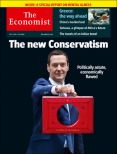
The Economist's take on the 2015 budget:
"Politically astute, economically flawed".
Picture Credit; Economist
The recent Conservative budget (the first Blue budget since 1996) was interesting mainly because it took inspiration from various Labour Party policies ("a living wage") while still sticking to traditional Conservative policies. Main details here, and analysis from the Economist's leader here. There is much to applaud, and also to critique.

However, more interesting is its impact on Labour.

The current Labour leadership battle is fascinating because (apart from anything else) it is a look at the various factions in the Labour Party.

Clearly for G and P students taking Units 1 and 2 in Summer 2016 it'll probably be useful background. By the time the exam takes place there will be a leader in place and there shall be the outline of Labour policy; essential for the "Party Politics" topic of Unit 1.

Despite winning 3 elections and being the most successful Labour leader ever, Tony Blair is despised by some in Labour circles for, principally at least, the Iraq war. His intervention in the Labour Leadership election became controversial, because he warns against Labour "turning left" - in other words becoming "Old Labour" rather than "New Labour".

Which brings us onto the leadership candidates. Details of them can be found here on the Wikipedia page - for our purposes at the moment there is the left-leaning Jeremy Corbyn and the Blairite Liz Kendall, plus Andy Burnham and Yvette Cooper who were part of the previous Labour regime. Stephen Daisley on STV has a great comparison of the different candidates here; most importantly he highlights quite how vicious and unpleasant it has become. For some left-wingers, Liz Kendall is not "Labour" enough and should be a Tory.

At time of writing Corbyn is in the lead prompting Blair's intervention. The battle seems to be between people who want to win elections by formulating policies which the public will vote for, and those who want to remain ideologically "pure".Typical of the genre is this rather unstructured tirade by Bryan Gould in the Guardian:

I have watched in disbelief as Labour leaders have sought to explain their unwillingness to stand firm and fight for what they supposedly believe. We are told that the voters’ support for further victimising those who have been left to pay the price of a recession for which they have no responsibility means that there is nothing further to be done.
“We can’t fight the electorate” is the siren call. But how are the voters likely to view a party that so manifestly lacks the courage of its convictions? Will they not conclude that Labour is fatally short of both courage and convictions?


By contrast here is fascinating analysis from Stephen Daisley; "it's not enough to be right, in politics you have to win too".

One of Daisley's important points is that Labour in the future not only has to win support from voters in England, but also has to win back support in Scotland - the SNP is doing very well and it will be a long battle to get Scotland back. This is a topic for another day:
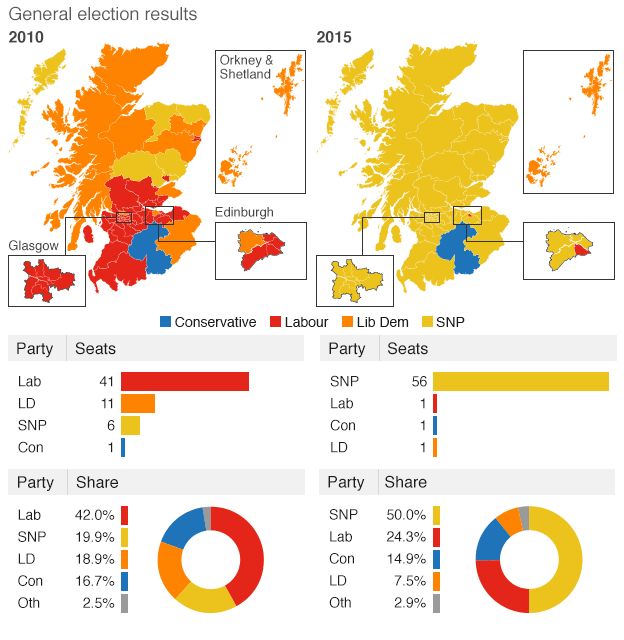
2015 Scottish General election result compared to 2010.
Picture credit; BBC.

Monday, 1 June 2015

2015 election - the most unfair ever?

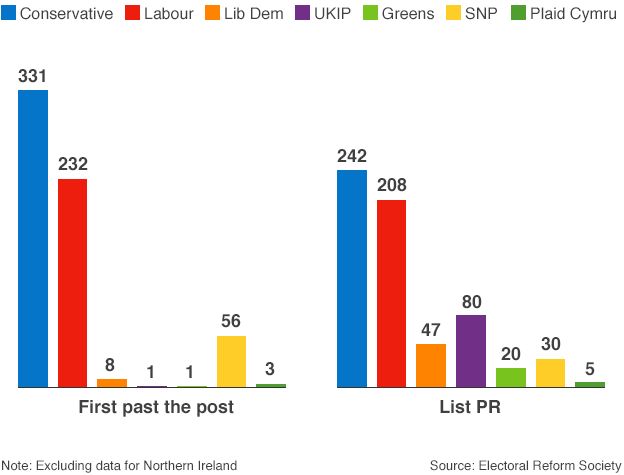
Sadly this came out too late to be of use to the Unit 1 paper taken this morning, but perhaps would be useful in future. The Electoral Reform Society has published research explaining how the 2015 election was the most "disproportionate in history". The BBC has a report about it here, and includes a set of graphs comparing the result of 2015 and then the same if run under a different voting system. To illustrate using List PR:

The 2015 election as run, and under a "List PR" system. 
Great stuff for anyone contemplating electoral reform in Unit 1. Props to AJB for the tip.

Thursday, 30 April 2015

Life under AV?

A quick post - I've just come across a BBC news page which discusses what the political landscape might be like had the UK said "Yes" to AV in 2011.

Although in the 2010 election the Conservatives and Labour would have lost out and the Lib Dems would have gained 32. According to Lord Ashcroft it's possible that the 2015 polling data would show a Conservative victory.

Great stuff!

Saturday, 4 April 2015

The Leaders' debate, the electoral system, and the party system.

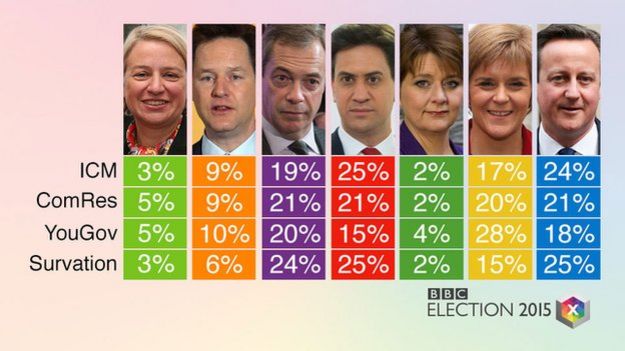
I'm not sure it tells us anything about the result, but the Leaders' debates served to show that the UK is really a multi-party system. Somewhat predictably, comments by Nigel Farage were later criticised. Snap polls after the debate show that the result is still close:

Picture Credit: BBC

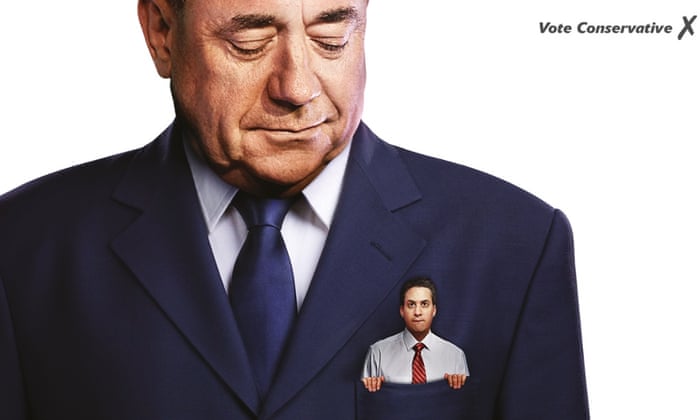
Picture credit: Conservatives / The Guardian

Perhaps most crucially 3 of these "minor" parties are now led by women.

In addition, it is no longer a 3-way battle for influence, the debate showed us that in the UK there are many parties which are claiming with some truthfulness that they represent a large portion of the population. As a result, the FPTP system is arguably now inadequate to the task of electing a stable government which can run Britain.

The likelihood of a major portion of the population feeling disenfranchised and left out is a real risk (imagine the effect on England of an SNP-Labour alliance in Westminster for instance). The Economist has a piece here which analyses the debate and reflects on the influence of the SNP.

SNP reply to Conservative poster. Credit: SNP / Herald Scotland
Analysis about the debate can be found here from the BBC, here from the Independent (which notes that the SNP's Nicola Sturgeon increased her support as a direct result of the debate), and the body-language is analysed here in the Guardian.

The Spectator analyses Cameron's prospects here (he did OK and didn't lose as badly as Miliband).

The Economist has a piece here about what the prospects are for Britain in the future (the TLDR summary is "not great").

For a bit of light relief, have a look at Buzzfeed's collection of the best jokes (eg. comparing the debate to a bad edition of "Take Me Out").

The whole thing can be watched here:


Or highlights can be found here:

Monday, 19 January 2015

Should voting be compulsory?

AJB has pointed me towards an article on the BBC's web-site which discusses whether voting should be compulsory. Great for the Democracy section of Unit 1.

In addition, he has also found this - an item on whether party leaders actually win elections. The short version - probably not.

In a related piece, the Independent covers three polls which came out at the same time, and which have different results - the answer is too close to call an probably won't be known until the election itself is run.

Great stuff!

Friday, 26 December 2014

Labour and Scotland - party differences?

A post on the BBC blog from Mark Mardell is fascinating for many reasons; for G and P students studying Unit 1, especially significant since it discusses the implication of devolution on party policy. The party has elected a former Blairite to be the leader of Labour in Scotland.

To be specific, the Labour Party in Scotland is likely to be more "left-leaning" than the party in Westminster as Scotland itself is on average (Mardell argues) more left-leaning than England is on average.

There are implications for the Labour party in the 2015 election; if it loses enough of its Scottish Westminster seats to the SNP as currently seems likely, then it will not be able to win power at Westminster. I posted about this earlier in the year:

Picture Credit: UK Polling Report
The implications for party policy across the UK is potentially significant, with parties increasingly having their own national policies better suited to local issues. This may in turn help lead to a more federal UK.

However, Labour is the only party which has (had?) a large established following in Scotland, closely followed by the Lib Dems. The Conservative Party has little power in Scotland, or much of Wales. Therefore, how the Labour Party deals with these issues over the next few years is potentially very important for the rest of the UK and its political parties.

This is also probably an issue worth bringing up in any question about party policy / traditions and devolution.