 |
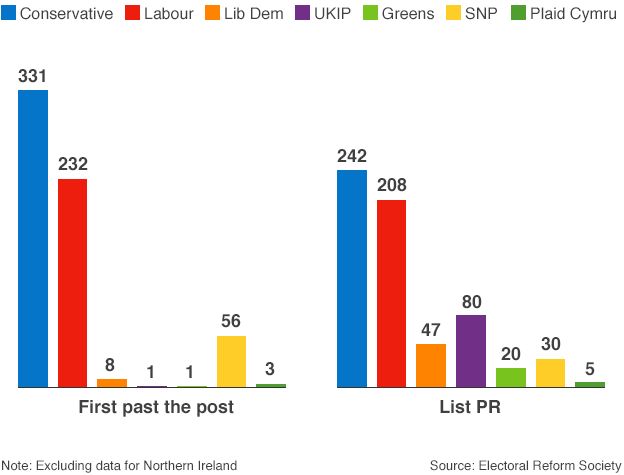
| The 2015 election as run, and under a "List PR" system. |
Showing posts with label FPTP. Show all posts
Showing posts with label FPTP. Show all posts
Monday, 1 June 2015
2015 election - the most unfair ever?
Sadly this came out too late to be of use to the Unit 1 paper taken this morning, but perhaps would be useful in future. The Electoral Reform Society has published research explaining how the 2015 election was the most "disproportionate in history". The BBC has a report about it here, and includes a set of graphs comparing the result of 2015 and then the same if run under a different voting system. To illustrate using List PR:
Great stuff for anyone contemplating electoral reform in Unit 1. Props to AJB for the tip.


Saturday, 4 April 2015
The Leaders' debate, the electoral system, and the party system.
I'm not sure it tells us anything about the result, but the Leaders' debates served to show that the UK is really a multi-party system. Somewhat predictably, comments by Nigel Farage were later criticised. Snap polls after the debate show that the result is still close:
Perhaps most crucially 3 of these "minor" parties are now led by women.
In addition, it is no longer a 3-way battle for influence, the debate showed us that in the UK there are many parties which are claiming with some truthfulness that they represent a large portion of the population. As a result, the FPTP system is arguably now inadequate to the task of electing a stable government which can run Britain.
The likelihood of a major portion of the population feeling disenfranchised and left out is a real risk (imagine the effect on England of an SNP-Labour alliance in Westminster for instance). The Economist has a piece here which analyses the debate and reflects on the influence of the SNP.
Analysis about the debate can be found here from the BBC, here from the Independent (which notes that the SNP's Nicola Sturgeon increased her support as a direct result of the debate), and the body-language is analysed here in the Guardian.
The Spectator analyses Cameron's prospects here (he did OK and didn't lose as badly as Miliband).
The Economist has a piece here about what the prospects are for Britain in the future (the TLDR summary is "not great").
For a bit of light relief, have a look at Buzzfeed's collection of the best jokes (eg. comparing the debate to a bad edition of "Take Me Out").
The whole thing can be watched here:
Or highlights can be found here:
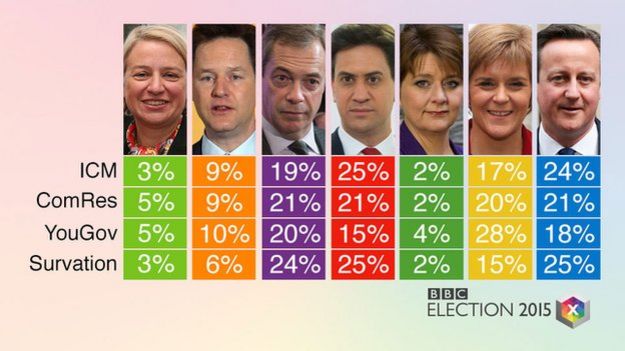 |
| Picture Credit: BBC |
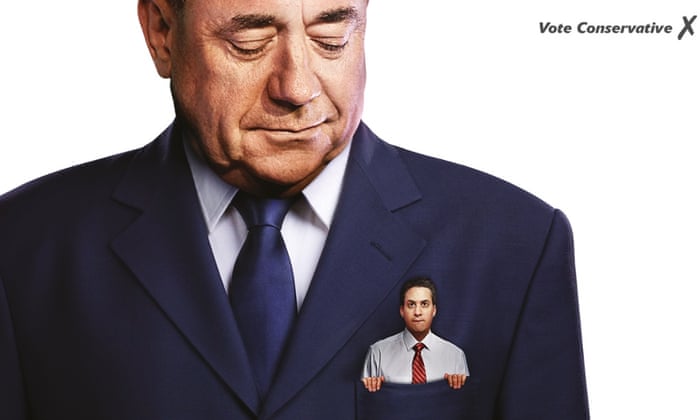 |
| Picture credit: Conservatives / The Guardian |
Perhaps most crucially 3 of these "minor" parties are now led by women.
In addition, it is no longer a 3-way battle for influence, the debate showed us that in the UK there are many parties which are claiming with some truthfulness that they represent a large portion of the population. As a result, the FPTP system is arguably now inadequate to the task of electing a stable government which can run Britain.
The likelihood of a major portion of the population feeling disenfranchised and left out is a real risk (imagine the effect on England of an SNP-Labour alliance in Westminster for instance). The Economist has a piece here which analyses the debate and reflects on the influence of the SNP.
 |
| SNP reply to Conservative poster. Credit: SNP / Herald Scotland |
The Spectator analyses Cameron's prospects here (he did OK and didn't lose as badly as Miliband).
The Economist has a piece here about what the prospects are for Britain in the future (the TLDR summary is "not great").
For a bit of light relief, have a look at Buzzfeed's collection of the best jokes (eg. comparing the debate to a bad edition of "Take Me Out").
The whole thing can be watched here:
Or highlights can be found here:
Wednesday, 15 January 2014
Marginal Constituencies in the UK
This article on the BBC web-site caught my eye; it is analysis of the effect marginal constituencies have on the behaviour of voters and on political parties.
In short, marginals decide elections. Political parties target those constituencies which are most crucial, and don't bother in seats that are safe. If the seat is safe for the other side any money spent is wasted. If the seat is safe for your party, why spend the money unnecessarily?
You can tell a seat is marginal if major politicians come calling asking for your vote.
The 2015 election is likely to be very tight and so seats like Luton south will probably see large amounts of money spent there by the parties; in 2010 parties spent £3.07 per vote (or a total of almost £130,000 between 12 parties).
The article mentions a report by the Centre for policy studies which suggested that 85% of seats are either marginal or have a good chance of their MP changing at the next election. Incidentally the report is also about voting reform, or as the title of the report has it "The evaporating case for electoral reform".
Great for G & P students contemplating the nature of elections and the importance of marginal constituencies. In addition, the idea that so many constituencies are marginal does suggest that the current electoral system is working and doesn't lead to democratic inertia. G & P students could usefully tie this to the fact that even under FPTP there is a coalition government rather than simply a single-party government.
 |
| Cooee! Major politicians go campaigning in marginals. Picture credit: BBC. |
In short, marginals decide elections. Political parties target those constituencies which are most crucial, and don't bother in seats that are safe. If the seat is safe for the other side any money spent is wasted. If the seat is safe for your party, why spend the money unnecessarily?
You can tell a seat is marginal if major politicians come calling asking for your vote.
The 2015 election is likely to be very tight and so seats like Luton south will probably see large amounts of money spent there by the parties; in 2010 parties spent £3.07 per vote (or a total of almost £130,000 between 12 parties).
The article mentions a report by the Centre for policy studies which suggested that 85% of seats are either marginal or have a good chance of their MP changing at the next election. Incidentally the report is also about voting reform, or as the title of the report has it "The evaporating case for electoral reform".
Great for G & P students contemplating the nature of elections and the importance of marginal constituencies. In addition, the idea that so many constituencies are marginal does suggest that the current electoral system is working and doesn't lead to democratic inertia. G & P students could usefully tie this to the fact that even under FPTP there is a coalition government rather than simply a single-party government.
Sunday, 9 May 2010
The 2010 election
It is obvious that no one party has total control of the House of Commons, despite a very large swing to the Conservatives and a loss for Labour of almost 100 seats. At least one commentator has called this almost as bad as the loss in the 1983 election.
Negotiations are on-going between the three main parties as to what the next step is; plenty of analysis and guess-work is available in most media, including the blogs listed on the left hand side of your screen. Minette Marrin in today's Sunday Times, and Andrew Sullivan both mention the extraordinary fact that the Conservative party would have won the election if Scotland's results were excluded, and that there is only one Tory MP north of the border. The analysis seems to suggest that a Tory administration which cut government spending severely would play into the hands of the SNP who could claim (quite legitimately) that the government had no mandate to perform these cuts north of the border. This would call into question the Union itself.
All of which is useful stuff for G&P students answering any question about why the British electoral system can be criticised. I would like to highlight the difference in result between the 2005 election where Labour won a clear majority with 66 seats on the basis of 35.3% of the vote, and the result of the 2010 election where the Conservatives won more of the vote with 36.1% but didn't win an overall majority with 307 seats.
The poor showing of the Lib Dems on 62 seats was a bit of a shock, but may reflect the fact that in the FPTP system we don't vote for the party leader but for members of their party to represent us; we make judgements about who to support based on a whole heap of local issues, rather than necessarily the national picture.
A key reason for having the FPTP system is that it tends to produce strong government, except that in this case it hasn't. Analysis from the BBC's Robert Peston suggests that coalition government would only happen in the event of a further financial crisis since there are significant obstacles to a stable government being created based on the voting done on May 6th, and more importantly further obstacles which may prevent government making the massive cuts necessary. As pointed out by him and Stephanie Flanders elsewhere there is currently little evidence that any party has got a credible plan to cut the deficit. Should the stock markets open on Monday thinking just that there will be severe problems in the city in terms of stock prices and the like.
Since economic policy is outside the scope of this blog and of the G&P course, I'll merely call attention to the events in Greece, and the potentially dire consequences to the UK, and the EU if a solution is not found. The Economist magazine's "Intelligence Unit" has suggested that a second election later this year is likely.
By way of contrast to the seriousness of the above, The Sun's front page on Saturday was very clever and funny.
Negotiations are on-going between the three main parties as to what the next step is; plenty of analysis and guess-work is available in most media, including the blogs listed on the left hand side of your screen. Minette Marrin in today's Sunday Times, and Andrew Sullivan both mention the extraordinary fact that the Conservative party would have won the election if Scotland's results were excluded, and that there is only one Tory MP north of the border. The analysis seems to suggest that a Tory administration which cut government spending severely would play into the hands of the SNP who could claim (quite legitimately) that the government had no mandate to perform these cuts north of the border. This would call into question the Union itself.
All of which is useful stuff for G&P students answering any question about why the British electoral system can be criticised. I would like to highlight the difference in result between the 2005 election where Labour won a clear majority with 66 seats on the basis of 35.3% of the vote, and the result of the 2010 election where the Conservatives won more of the vote with 36.1% but didn't win an overall majority with 307 seats.
The poor showing of the Lib Dems on 62 seats was a bit of a shock, but may reflect the fact that in the FPTP system we don't vote for the party leader but for members of their party to represent us; we make judgements about who to support based on a whole heap of local issues, rather than necessarily the national picture.
A key reason for having the FPTP system is that it tends to produce strong government, except that in this case it hasn't. Analysis from the BBC's Robert Peston suggests that coalition government would only happen in the event of a further financial crisis since there are significant obstacles to a stable government being created based on the voting done on May 6th, and more importantly further obstacles which may prevent government making the massive cuts necessary. As pointed out by him and Stephanie Flanders elsewhere there is currently little evidence that any party has got a credible plan to cut the deficit. Should the stock markets open on Monday thinking just that there will be severe problems in the city in terms of stock prices and the like.
Since economic policy is outside the scope of this blog and of the G&P course, I'll merely call attention to the events in Greece, and the potentially dire consequences to the UK, and the EU if a solution is not found. The Economist magazine's "Intelligence Unit" has suggested that a second election later this year is likely.
By way of contrast to the seriousness of the above, The Sun's front page on Saturday was very clever and funny.
Subscribe to:
Posts (Atom)