Contributors

Showing posts with label labour leadership battle. Show all posts

Thursday, 23 July 2015

Party politics - Labour party in-fighting, and Conservative policies

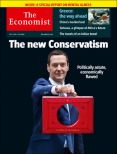
The Economist's take on the 2015 budget:
"Politically astute, economically flawed".
Picture Credit; Economist
The recent Conservative budget (the first Blue budget since 1996) was interesting mainly because it took inspiration from various Labour Party policies ("a living wage") while still sticking to traditional Conservative policies. Main details here, and analysis from the Economist's leader here. There is much to applaud, and also to critique.

However, more interesting is its impact on Labour.

The current Labour leadership battle is fascinating because (apart from anything else) it is a look at the various factions in the Labour Party.

Clearly for G and P students taking Units 1 and 2 in Summer 2016 it'll probably be useful background. By the time the exam takes place there will be a leader in place and there shall be the outline of Labour policy; essential for the "Party Politics" topic of Unit 1.

Despite winning 3 elections and being the most successful Labour leader ever, Tony Blair is despised by some in Labour circles for, principally at least, the Iraq war. His intervention in the Labour Leadership election became controversial, because he warns against Labour "turning left" - in other words becoming "Old Labour" rather than "New Labour".

Which brings us onto the leadership candidates. Details of them can be found here on the Wikipedia page - for our purposes at the moment there is the left-leaning Jeremy Corbyn and the Blairite Liz Kendall, plus Andy Burnham and Yvette Cooper who were part of the previous Labour regime. Stephen Daisley on STV has a great comparison of the different candidates here; most importantly he highlights quite how vicious and unpleasant it has become. For some left-wingers, Liz Kendall is not "Labour" enough and should be a Tory.

At time of writing Corbyn is in the lead prompting Blair's intervention. The battle seems to be between people who want to win elections by formulating policies which the public will vote for, and those who want to remain ideologically "pure".Typical of the genre is this rather unstructured tirade by Bryan Gould in the Guardian:

I have watched in disbelief as Labour leaders have sought to explain their unwillingness to stand firm and fight for what they supposedly believe. We are told that the voters’ support for further victimising those who have been left to pay the price of a recession for which they have no responsibility means that there is nothing further to be done.
“We can’t fight the electorate” is the siren call. But how are the voters likely to view a party that so manifestly lacks the courage of its convictions? Will they not conclude that Labour is fatally short of both courage and convictions?


By contrast here is fascinating analysis from Stephen Daisley; "it's not enough to be right, in politics you have to win too".

One of Daisley's important points is that Labour in the future not only has to win support from voters in England, but also has to win back support in Scotland - the SNP is doing very well and it will be a long battle to get Scotland back. This is a topic for another day:
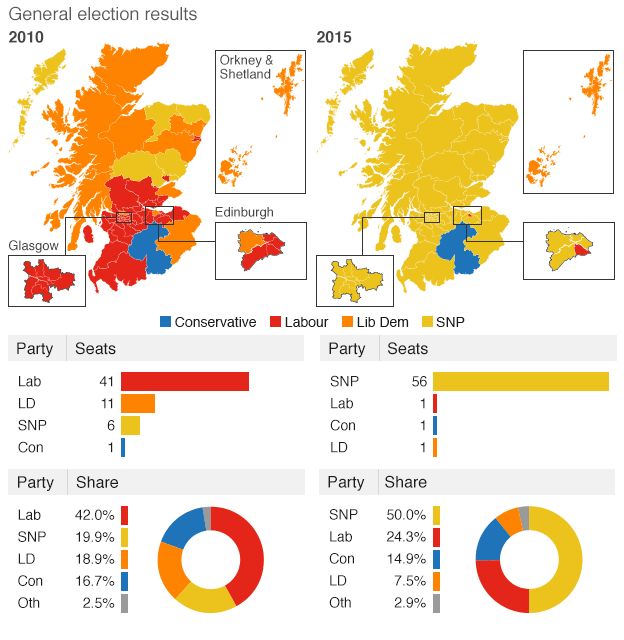
2015 Scottish General election result compared to 2010.
Picture credit; BBC.

Saturday, 4 September 2010

Labour leadership race

I haven't posted about the Labour leadership race since it will be resolved and a new leader installed by the time AS students take their exams in summer 2011. However, I though it was worth noting an article by The Economist's Bagehot.

Essentially, the race is between the two brothers MiliE and MiliD who have been portrayed as miles apart in political terms (David as a Blairite, Ed as a Brownite). Bagehot commented:

The press is full of commentary about British politics that would have you believe that the political landscape echoes to the metallic din of ideological combat. Yet when you look carefully at what the politicians from the largest parties are saying, none of it seems so very far from the centre-ground.

Take the Labour leadership race, which by common consent revolves around the two Miliband brothers. According to the newspaper narrative, Ed Miliband, the younger brother and former cabinet minister in charge of climate change, is significantly to the left of David Miliband, the elder brother and former foreign secretary. I have seen the word Bennite bandied around, in homage to Tony Benn, the former Labour cabinet minister who really was a proper lefty in his day, advocating capital controls and the wholesale nationalisation of British industry. It is true that the pair have been sending little hints and signals since the contest became a two horse race, indicating that MiliE is to the left of MiliD (as some call them) and is more tempted than MiliD by some form of core vote strategy to woo back disaffected Labour voters and former Liberal Democrat voters who are disgruntled by the Con-Lib coalition. But Bennite? Come off it.

Quite who the eventual leader will be should prove interesting, especially as Labour and the leadership contenders have a large problem: The credit crunch and the resulting recession was undoubtedly caused by a failure of the banking system ("market forces"), but there is an argument to be had that there was also a failure of government regulation.

The same government which was lead by Blair and Brown and had Milibands E. and D. as well as Balls E. in major positions in the Cabinet. It is therefore in their interests as prospective leaders of the opposition, as well as potential Prime Ministers if the coalition doesn't last the full term, to say that "it wasn't anything to do with us guv". This also ties neatly into the anti-big-business instincts of the average Labour Party member.

The argument about why the credit crunch happened will run and run, and is also outside the remit of this blog. However, a brief taste of some very technical arguments can be found here and here in the Democracy in America blog. Admittedly these are about the US-side, but the credit crunch was a global event closely linked to the American situation and these postings have some pertinent things to say about the UK.

All useful stuff for anyone contemplating the direction of the Labour Party and that classic exam question "Has the Labour party abandoned socialism?"

As a side note, Robert Peston has some interesting things to say about party funding; essentially Labour is heavily reliant on a small number of very wealthy individuals and Trades Unions, and the Conservatives still rely on the City of London's firms for their party funds. This obviously brings up the question of how much these funds determine the direction of party activity and policy formation.

Tony Blair's memoirs are analysed in many places, including here in the Guardian and here and here in the Economist, which has a comment about the nature of politicians who chase voters:

...At best, progressive politicians can hope to define themselves by fixed values, such as concern for the poorest at home and abroad, rather than by policies with fixed party labels.

This is quite a comforting analysis, of course, if you happen to be a former party leader who bet big that likeability trumped traditional party boundaries. But it is possible to find Mr Blair self-serving yet his description of how real voters think and act convincing. In pursuit of governments which speak to their instincts, lots of people may switch from party to party, while feeling they are being perfectly consistent.

There is a pointed lesson here for Labour members as they choose a new leader this month. They need to decide whether they are choosing a new boss for their party, or one who could plausibly belong to the country as a whole, as a future prime minister. Mr Blair has not endorsed a candidate (probably to the relief of all concerned). But then again he barely needs to. Like customers, voters are always right in his world: that is who he is.

To close, that picture of David Miliband which will follow him to his grave:

Friday, 6 August 2010

Labour leadership race and the coalition

An interesting piece here from Bagehot in the Economist, discussing the Labour leadership race (we're in for a Miliband), and the direction of the coalition and conservatism under David Cameron (he's not merely a Thatcherite, but something more interesting).

Friday, 16 July 2010

Coalition policies - progressive or conservative in disguise?

The new Lib-Con coalition government has produced some thought-provoking new policies. Overall, they seem progressive and more liberal in a classical sense than conservative, and are going ahead with these policies at a time of major government spending cuts. Labour claims that the cuts are the "same old Tory" cuts which are what they would have done anyway because that is what Tories have always done.

The key problems for Labour are:

1. They are in the middle of a leadership election, in which the candidates are trying to appeal to Labour party members who, um, support Labour and like having increased government spending which is geared towards helping the poor.
2. They have just been kicked out of office after having caused a big structural defict of around 8% of GDP in 2009 (i.e. excluding the effects of the recession, government spending massively outstrips government income in the shape of taxes). This should be put in the context of the overall £90bn deficit reported in 2009.
3. It's more or less what they would have done if they had been in power. Further analysis of the parties' budget plans can be found in this presentation from the IFS from April 2010. Page 29 shows the overall cut in spending and increase in taxes planned per year being £15.8bn by Labour, £10.1bn by the Conservatives, and £19.7bn by the Lib Dems.

Further analysis of the budget deficit can be found elsewhere, including this 2008 PDF from the Institute For Fiscal Studies. The graph below (from the BBC) says it all I think:


It'll be interesting to see how the leadership election turns out and what the effect will be on Labour policy, especially given that it is very likely the coalition will not survive its full five year term, and Labour will have to have a credible set of policies in preparation for a quick return to government. It is, of course, possible the coalition will survive the 5-year term.

Some coalition policies of note are: a referendum on the AV-voting system, instead of FPTP next May (seen by Nick Robinson as a date which may make or break the coalition), Justice Secretary Ken Clarke on reform of prisons and sending fewer people to prison (aka "prisons don't work"), Education Secretary Michael Gove setting up new types of school independent of central control ("Free Schools", and a reform of the NHS which gives GPs more power, and a fixed-term parliament.

I'll explore some of these policies further in the future as they develop. All useful stuff for any essay about political parties and their policies, although there is plenty of time between now and the exam in May/June 2011, so much may change.

A final note about former new Labour spin doctor Peter Mandelson. What I've read of his book, serialised in the Times this week, has been interesting but it has not exactly said anything we didn't know already; that new Labour and Tony Blair and Gordon Brown really didn't trust eachother, and spent time arguing about power when they should have spent all their energy running the country. It is an interesting contrast to the coalition government and the trust which civil service chief Sir Gus O'Donnell said was key in cementing the agreement between the Lib Dems and the Conservatives, and between Nick Clegg and David Cameron in particular.

Just watch the coalition's first joint news conference:

Wednesday, 9 June 2010

UK - Labour and Conservative healthcare contrast

The new government has been unveiling some of its policies, but largely remained coy about revealing information about spending plans, as Nick Robinson says here. An interesting revelation about health-care policy from Andrew Lansley the new Health Secretary of State in a recent speech; essentially the new government will be scrapping some of the new Labour targets (specifically the 4-hour waiting-time target at A&E, which is supposed to have some severe negative impacts).

Useful for anyone contemplating some of the key differences between new Labour and the Lib-Con government.

When there is something more concrete about the measures to cut the deficit, I'll post, but suffice to say this piece by Robert Peston about the international lessons for the UK, and this one by Stephanie Flanders about how bad news on the economy has played into the government's hands have much for us to ponder upon. Whether any party has done enough in the run up to the election to spell out how severe the cuts will have to be, is anybody's guess. Does the coalition government have enough of a mandate to pursue its policy in this area? We'll see. Check out my previous post about the deficit-mandate-manifesto issue and George Osborne here.

In addition to the above, the Labour Party leadership battle rumbles on. I'm not convinced that there has been enough debate to enable the Labour party to move on after the Blair-Brown years, or that enough profound lessons have been learned. Is the next leader of the Labour party the next William Hague or Michael Foot? Let's watch out for those debates.