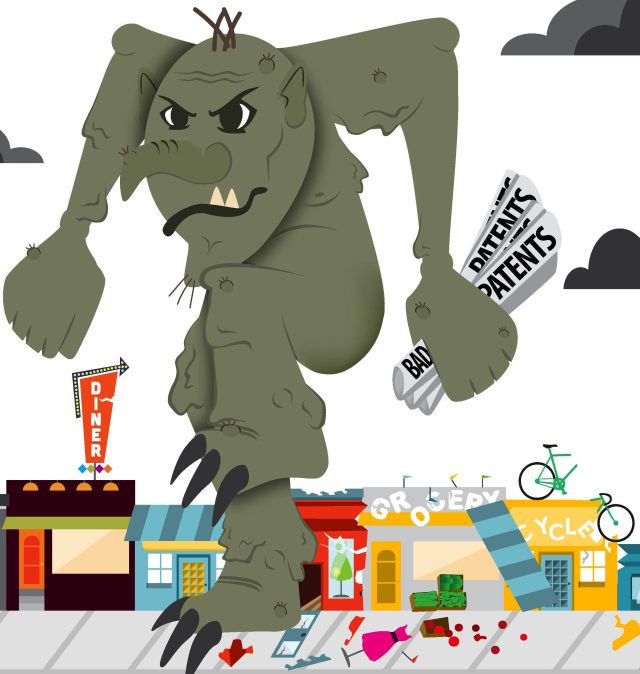
The magazine Ars Technica has a report about a pressure group called "Stop Bad Patents" which is starting a new campaign to get Congress to stop "Patent Trolling" - companies which buy up patents and then sue other businesses for using these patents. The trouble is that while the action can be seen as entirely spurious, it is generally cheaper to settle than to go through the courts.
The Pressure Group's web site can be found here.
[Picture - Ars Technica]
A blog about politics in the UK and the US designed for students of Edexcel Government and Politics Units 1, 2, 3C & 4C. Updated irregularly by teachers of History and Politics.
Showing posts with label Pressure Group. Show all posts
Friday, 30 August 2013
Wednesday, 22 May 2013
Pressure groups and abortion in the USA
A quick posting to highlight the impact that abortion is having on the Republican party. According to this article at Salon.com, the issue can be seen as partly to blame for some of the losses the party suffered in the 2012 election cycle.
Probably the most useful item from the point of view of a student of A2 politics, and Unit 3C is the impact that a pressure group calling itself the "Susan B. Anthony List" had on the selection of Republican candidates in the 2012 election.
As I am on the subject of Pressure Groups, the Economist magazine's Democracy in America blog discusses Facebook's Mark Zuckerberg's new pressure group, "FWD.us", which is campaigning to change the rules about immigration.
As AJB and I repeatedly emphasise, it's important to have up-to-date examples for the exam.
[Picture Credit - Wikimedia Commons & The Economist]
Probably the most useful item from the point of view of a student of A2 politics, and Unit 3C is the impact that a pressure group calling itself the "Susan B. Anthony List" had on the selection of Republican candidates in the 2012 election.
As I am on the subject of Pressure Groups, the Economist magazine's Democracy in America blog discusses Facebook's Mark Zuckerberg's new pressure group, "FWD.us", which is campaigning to change the rules about immigration.
As AJB and I repeatedly emphasise, it's important to have up-to-date examples for the exam.
[Picture Credit - Wikimedia Commons & The Economist]
Saturday, 15 January 2011
What is the left for if it isn't for spending money?
Labour leader Ed Miliband has at last explained briefly what he stands for - it is somewhere between Blairist use of the market to ensure efficiency and produce centrally-driven public service reforms, and traditional left-wing big government initiatives to produce a "rebalanced" economy.
He has of course made a little headway with the Labour vote increasing slightly after the recent by-election in Oldham:
The Lib Dems didn't do too badly - while their vote did slip, they are in government and traditionally parties in government do badly in by-elections. That's not forgetting the issue of cuts which the Government is inflicting on the nation.
This item on the BBC web-site highlights the desire for MiliE to appeal to disaffected Lib Dem voters (how dare the party of liberal idealism actually have to make difficult choices while in government and actually, well, govern!). Interesting for G&P students in the way that MiliE tries to cast the choice that the Lib Dems made last may in going into Coalition as a "tragic mistake" - personally I don't think they had a realistic alternative. A Lib Dem-Labour coalition would have been weak and would have fallen quickly ("a coalition of the loosers"). It would not have had the necessary seats in the House of Commons to demand a majority.
This post from the BBC's Nick Robinson has some very pertinent things to say about the way that MiliE's thinking is going:
The Coalition has raised all sorts of questions over how parties approach issues and probes the way that party allegiances are currently mapped out. It wouldn't be beyond possibility that the dissatisfied Lib Dem supporters (former SDP / Labour members) would return to the Old party fold. The trouble is, that while it's all very well to be idealistic and to promise not to raise University Tuition fees (as the Lib Dems did before the election) when you are not expecting to have to go along with any promise you make.
The Lib Dems have for years been the posturing opposition to business as usual. When thrust into Government, tough choices have to be made, especially at a time when there are significant questions over government debt. Any party not prepared to govern is merely a Pressure Group.
He has of course made a little headway with the Labour vote increasing slightly after the recent by-election in Oldham:
The Lib Dems didn't do too badly - while their vote did slip, they are in government and traditionally parties in government do badly in by-elections. That's not forgetting the issue of cuts which the Government is inflicting on the nation.
This item on the BBC web-site highlights the desire for MiliE to appeal to disaffected Lib Dem voters (how dare the party of liberal idealism actually have to make difficult choices while in government and actually, well, govern!). Interesting for G&P students in the way that MiliE tries to cast the choice that the Lib Dems made last may in going into Coalition as a "tragic mistake" - personally I don't think they had a realistic alternative. A Lib Dem-Labour coalition would have been weak and would have fallen quickly ("a coalition of the loosers"). It would not have had the necessary seats in the House of Commons to demand a majority.
This post from the BBC's Nick Robinson has some very pertinent things to say about the way that MiliE's thinking is going:
Ed Miliband does not yet have a convincing narrative which excuses the previous government for its mistakes and flagrant dishonesty with the obvious truth. Nor yet does he have a clear indication (beyond warm words) of where he will be taking his party, and how he can put Labour-friendly policies into action without any money to spend as previous Labour governments have done:My sense is that Ed Miliband's speech is made up of the things he instinctively believes and those bits of political positioning he's been advised to adopt. His own views are interesting. At one point he argues: "We can't build economic efficiency or social justice simply in the way we have tried before. It won't be enough to rely on a deregulated market economy providing the tax revenues for redistribution. New Labour's critical insight in the 1990s and 2000s was that we needed to be stewards of a successful market economy to make possible social justice through redistribution. The critical insight of Labour in my generation is that both wealth creation and social justice need to be built into the way our economy works."By this he says he means a high wage economy, the introduction of a Living Wage and respect for communities so that their concerns about government targets, out-of-town supermarkets and post office closures are not simply ignored in the name of efficiency. What he does not say is how this rebalanced economy - something which, incidentally, I have heard both George Osborne and Vince Cable call for - can be created. Watching how his thinking develops will be fascinating.
Ed Miliband needs not only to provide a credible alternative to the coalition's policy of cuts and "Maoist" public service reforms. He needs to explain what social democratic politics looks like in an era without easy money to spend. To do so he may need to develop an account of Labour's period in office that addresses more than just a failure to regulate the banks and a slowness of language.
The Coalition has raised all sorts of questions over how parties approach issues and probes the way that party allegiances are currently mapped out. It wouldn't be beyond possibility that the dissatisfied Lib Dem supporters (former SDP / Labour members) would return to the Old party fold. The trouble is, that while it's all very well to be idealistic and to promise not to raise University Tuition fees (as the Lib Dems did before the election) when you are not expecting to have to go along with any promise you make.
The Lib Dems have for years been the posturing opposition to business as usual. When thrust into Government, tough choices have to be made, especially at a time when there are significant questions over government debt. Any party not prepared to govern is merely a Pressure Group.
Labels:
AS,
coalition,
Ed Miliband,
Labour,
Lib Dem,
Pressure Group
Subscribe to:
Posts (Atom)


