Contributors

Showing posts with label Presidential power. Show all posts

Friday, 3 April 2015

Presidential Foreign Policy - Obama and Iran

President Obama's recent negotiations with Iran and the rest of the "P5+1" (US, UK, France, Germany, China and Russia) have come up with a "historic" agreement to stop Iran from building a nuclear bomb. 

Certainly a good example to use when discussing the power of the president and foreign policy; however, there is still much work to be done and this is not actually an agreement as such. It is an agreement to continue working towards an agreement.

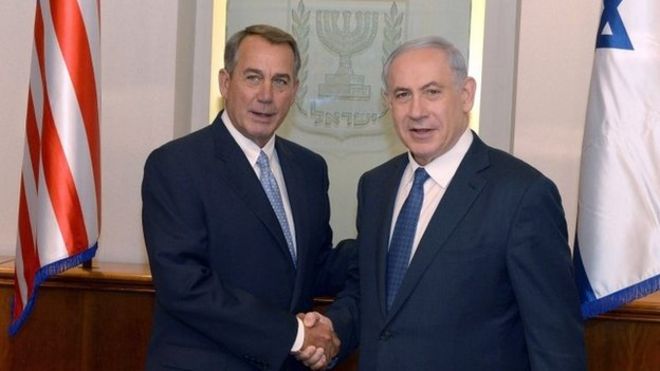
Of more use for any G and P student working towards Unit 4C is the idea that Congress can scupper the deal; Israeli Prime Minister Benjamin Netanyahu's speech to Congress essentially went over the head of the President and was an appeal to Congress (or more specifically the Republican-dominated Congress) not to allow Obama to leave Israel weakened.
Republican Speaker Boehner & Israeli PM Netanyahu.
Picture Credit: BBC

As a result, the President is likely to find it hard to get any Iran deal through Congress - although there may be technical ways of avoiding or limiting the Republican Party's power, the Senate has the power of "advice and consent" over treaties negotiated by the President.

Further analysis by the NY Times here, Netanyahu's comments about the agreement here, and the BBC analyses the power of Congress here.

Great stuff for any G and P student contemplating Presidential power over foreign policy.

Saturday, 28 February 2015

Republican Conservatism according to Rolling Stone

I've just come across this piece from Rolling Stone Magazine which explains an aspect of modern tea-party-inspired Republicanism:
The entire narrative of modern conservative politics casts the United States as a fast-disappearing Eden of freedom and democracy that's under siege both here and abroad, surrounded by a constellation of enemies united (for some never-fully-explained reason) in their passionate hatred for the simple, God-fearing, freedom-loving American.
While this rock'n'roll magazine is by design fairly liberal, it is certainly food for thought for anyone contemplating the nature of Republicanism (although for my money I don't think that quoting Fox News and saying that it can be very anti-liberal is especially surprising).

Protests in the snow against a pipeline. Picture credit - BBC

Elsewhere, the President has done his third veto about the "Keystone" pipeline between Canada and USA - essentially to make the point that only the President can make international agreements and not Republicans in Congress.

Embedded is a great video explaining why the pipeline is so controversial:


Monday, 19 January 2015

Big Block of Cheese Day

Anyone who is a fan of the West Wing TV show should remember an episode in Season 1, called "The Crackpots and These Women", where Leo refers to President Andrew Jackson who put a big block of cheese in the White House for anyone who wanted it. In the TV drama special interest groups are given access to senior staff to press their causes.

The real White House has taken this as inspiration and created their own "Big Block of Cheese Day"; this time on the internet. Specifically they are devoting a day after the State of the Union on 20th January for members of the Obama administration to answer questions on line about issues raised in the set-piece speech.

For G and P students studying Unit 4C this is useful because it is a good example of the President's administration communicating their ideas with the public. It is also a good example of when the President is trying to press his agenda in the media using the "bully pulpit" of the State of the Union.

Here is the video from the White House with a few familiar faces thrown in:


Wednesday, 10 December 2014

Senate Report on Torture

The Senate, in its last days before becoming Republican-dominated, has just published a report into the interrogation techniques used by the CIA after 9/11.

G and P students should bear this in mind when considering the effectiveness of Congress's oversight of the Executive; finally these techniques are called "torture". However, according to Rolling Stone no-one will get prosecuted for it.

The article discusses the likelihood of the Obama administration being investigated for similar things in future, and reckons it's probable. However, this all may be more about political partisanship than effective oversight by the legislature.

Fascinating stuff.

Thursday, 6 November 2014

Mid-terms 2014

The Mid-terms saw both the House and the Senate being controlled by the Republicans. Further detail about races and the overall view here from the BBC. For example, Democratic Representative for New York Louise Slaughter, an experienced member of Congress, won by the narrowest of margins; 50.2% to 49.8%. "Blue-Dog" Democrat John Barrow lost, meaning that conservative Democrats are largely extinct in Congress.

What are the prospect for the US Government in the next two years? President Obama and new Senate Majority Leader Mitch McConnell have pledged to work together on issues they both agree in (tax reform and foreign trade pacts).

Further analysis here from the Economist, which highlights the problem - the Tea-Partiers and others may not allow the two to work together. Rolling Stone magazine discusses this very issue here, and looks forward excitedly to the battle within the Republican Party and the Presidential election of 2016.

All of which is great for G and P students contemplating the powers of Congress and the President for Unit 4C and elections in Unit 3C. If there is continued gridlock (something the Republicans are trying to blame on the Democrats), the President may well use executive orders to get things done; for example on immigration.

It must be borne in mind, however, that the turnout for these mid-terms is very low, and is lower than the last mid-terms in 2010 (there is a great map and selection of graphs on this page). Overall, it was 36.6% down from 40.9%; somewhat predictably, Democrat-supporting voters were the least likely to turnout to vote.

As a final note, Rolling Stone's October issue had a great article by Economist Paul Krugman favourably evaluating the Obama Presidency. Well worth a read.

Sunday, 20 July 2014

New events in US Politics - Summer 2014

In brief a potentially significant Supreme Court decision has been made which undermines Obamacare and also has implications for how religion is treated in the USA. The short version is that a firm is now going to be treated like an individual in respect to its religious beliefs, and that these can now not be forced to obey federal law. See here and here for analysis from the Economist. The decision is called Burwell v Hobby Lobby (click here for the Wikipedia page). The Washington Post has more here.


 Gov and Pol students for Unit 4C could use this when discussing the power of the President and the significance of the Supreme Court.

In early August, President Obama was sued by Congress for being a tyrant, with analysis by the Economist here. Good for anyone contemplating Presidential power and the power of Congress. Worth bearing in mind that the Republican-controlled House has tried over 50 times to destroy Obamacare. This is also useful when contemplating the interests of the Republican Party.

Elsewhere, the current 112th Congress is shaping up to be the least productive in history. Details and analysis from the Washington Post, plus some analysis from Ars Technica about the issue. While it may be expected that there would be little progress on the major issues (Obamacare, taxes, etc), some minor ones (Internet Trolls, copyright reform) don't see any progress either. Useful stuff for Gov and Pol students contemplating the (in)ability of Congress to get things done.

Against the background of this, the inability of Congress to address immigration effectively is striking. A passionate article in Rolling Stone discusses the impact of the Tea Party on efforts to address the 90,000 unaccompanied and undocumented minors who try to enter the country from Mexico every year. The short version is that Tea Party Republicans (Ted Cruz etc) have refused to allow funds to be used to help these refugees, and instead have agitated for increased border security. The political impact is affecting President Obama's standing too.


In another development, left-leaning former Supreme Court Justice Stevens has written a book proposing 6 new amendments to the US constitution. The wording of the amendments themselves are detailed in this blog post by an assistant law professor in South Texas. The book itself and its implications are reviewed here in the Huffington Post and here in the Wall St Journal.

Further analysis at another time I think, but for now the WSJ makes a very useful point; while Justice Stevens highlights some of the major flaws in the US political system (Gerrymandering, the Death Penalty, Gun Ownership), he sees Amending the constitution as the solution. As Gov and Pol students will be / are aware this is a long and complex process, so perhaps Congress passing laws would be a better solution.
Thursday, 20 February 2014

Presidential Power - LBJ

Inspired by a recent watch of the Netflix hit "House of Cards" - a tale of dastardly political in-fighting in Congress (which was based on a BBC mini-series of the same name), here are a selection of pictures which highlight President Johnson's negotiating tactic with opponents (known as "The Treatment"):

LBJ and Senator Russell.
Picture Credit: Wikipedia

LBJ in the NY Times
Picture Credit; NY Times
LBJ and  Supreme Court Justice Abe Fortas
Picture credit: unknown / All This is That
All of which might be a good example to use when discussing Presidential Power which, like Prime Ministerial power, is concerned with the structures of power, as well as the individual circumstances and the personal characters too.

Wednesday, 29 January 2014

State of the Union 2014

Just because I can, here is a video of some highlights from the State of the Union address 2014:


Essential viewing for any G and P student contemplating the power of the US president - especially as he approaches the Mid-terms and the final quarter of his presidency when he will be a "lame duck". The BBC's analysis can be found here.

The Washington Post analyses here, leading with the pledge that Obama will act, without Congress if necessary, to help alleviate inequality in the USA. G and P students should be aware of the methods the President would be likely to use - Executive Orders and directing the relevant departments.

Students should also not forget the Clinton-era description of these powers as "Stroke of the pen, law of the land. Kinda cool".

The threat by the President to go it alone without Congress is also a reflection on Congress' willingness to act. G and P students could also use this to help analyse whether Congress is effective.

The complete Address can be found below, courtesy of PBS and Youtube.

Wednesday, 18 December 2013

Pressure Groups USA - Tech companies

The White House.
Photo Credit: Tom Lohdan / Ars Technica
In brief, as a follow on an earlier post I made back in August about the revelations by Edward Snowden about the NSA spying on US citizens and foreigners with little oversight, I came across this nugget of useful information.

According to Ars Technica and the Washington Post had a meeting this week at the White House in which they "discussed" the revelations about the NSA. The exact details of the hacking by the NSA I don't think are especially relevant to G & P students (although they are interesting and quite extraordiary).

More pertinent is the idea that major companies are operating as pressure groups to change the way the executive operates. A great example for G & P students contemplating Pressure groups in Unit 3C. It is also a great example if anyone is contemplating the power of the president (the NSA's activities started in 2006 under Bush Jr).

In a low federal court (crucially not the Supreme Court, so this statement is not binding), a judge has said that some of the NSA's activities are "unconstitutional". The Federal Government is going to appeal. This is one of a number of cases to be brought to trial by various parties, including the ACLU outraged by the Federal Government's activities. One can imagine this ending up at the Supreme Court in due course.

There is an issue whether this government agency was acting under the supervision of the President or whether it was not. This is a judgement which I will leave to others.

Sunday, 8 December 2013

The End of the Filibuster in the Senate? by Charles Ashie

On Thursday 21st of November, there was a historic change in the Senate that in turn, will alter centuries of precedent. In the past, when a bill has got to the Second Reading, there is the opportunity for the opposition of the bill (normally the minority party) to essentially "talk a bill to death" 

This is called a filibuster. It can be done by an individual senator or a group of senators and they are not allowed to go to the toilet, or even sit down. 

 Filibuster topics have ranged from reading out extracts from the Constitution, the Declaration of Independence, or even Green eggs & Ham by Dr Seuss. One may think that it is an impossible feat but the record for an individual senator goes to Sen. Strom Thurmond of South Carolina, who spoke for 24 hours and 18 minutes against the Civil Rights Act of 1957. 

A procedure known as cloture is necessary for a filibuster to be ended. This did require a super majority vote (60 votes, three-fifths of the Senate) as well as a signature from 16 senators. 


Filibusters and cloture motions in the Senate since 1919.
Picture Credit: Washington Post
 However as of last Thursday the Senate voted, in a 52 to 48 vote, to require only a majority vote to end a filibuster of certain executive and judicial nominees, not including Supreme Court nominees, rather than the 3/5 of votes previously required.

This is significant because it now allows President Obama to get Senate approval for a large number of executive appointments; numerous senior federal judges have not been appointed for example.

Useful for any G&P student contemplating the power of Congress and the Senate in particular. The power of the President is also an issue related to this too. Republicans were seemingly against any Obama appointment, so they stopped all of them. 

However as the Washington Post says here, the reforms mean that "Senate Republicans retain the power to slow, though not derail, Obama’s appointments". 

In addition to the links above, there is a long Huffington Post about it all here, and a blog post from the Washington Post also discusses it here.

Monday, 7 October 2013

13 Reasons why the US government isn't working

Fig 1 - Filibusters and Cloture motions 1917-2012.
Source - washingtonpost.com
I've just come across this article in the Washington Post. It details 13 reasons the US government isn't working. 

Although a round-up of the usual suspects, it is a pretty useful run-down of a variety of causes, including the polarization of the political parties (the graph below shows this pretty well), the Tea Party, gerrymandering in the House and the filibuster.

The conclusion it comes to is pretty startling, but on the whole, a very useful article for anyone contemplating the US government, Congress and the power of the President in unit 4C.
Fig 2 - Average party political position
Source - washingtonpost.com

In a long article in the New York Review of Books, Elizabeth Drew discusses the impact that low turnout has had on US politics - the short version is that it has encouraged the extremist wings of the parties to get out the vote and this in turn has made the political system more polarized. It does have some extraordinary tales of political skulduggery, but in general it has some of the same thrust as the earlier post in the Washington Post.

Esteemed economist Paul Krugman in the Washington Post describes the Republican Party "incompetence", and links to a review of a book by Mann and Ornstein called "It's even worse than it looks". G & P students may have come across the idea of Congress as "the Broken Branch" - these are the two authors who came up with the phrase. They have some very unpleasant things to say about the Republicans:

Today’s Republicans in Congress behave like a parliamentary party in a British-style parliament, a winner-take-all system. But a parliamentary party — “ideologically polarized, internally unified, vehemently oppositional” — doesn’t work in a “separation-of-powers system that makes it extremely difficult for majorities to work their will.”

Food for thought, and probably essential reading for the 2013 exams.

Update - 10th October 2013

RollingStone Magazine has published a very long article putting the current division between political parties into historical context. Essential reading for anyone contemplating the different party positions for Unit 3C, and because it explains some of the finer points of the debt crisis.


Tuesday, 1 October 2013

US government shut-down

Well, the big news is that the US government has shut down because the two chambers of Congress could not come up with a solution to the budget problems that satisfied everybody.
Picture source: The Economist. 

The argument essentially was that the Republicans (or even more specifically the Tea-Party wing) wanted to delay, or overturn or defund Obamacare, and the Democrats said they couldn't.

There are a whole lot of different topics in G & P units 3C and 4C which could use this event as an example; the power (or inadequacy) of Congress, the power of the President, Political parties and their factions, not to mention the Supreme Court which upheld Obamacare in the face of challenges to it.

Interesting commentary from the Republican-leaning Washington Post which blames the Tea Party for having no grasp of political reality. Elsewhere on the Washington Post web-site there is older analysis which says that this plays into the hands of the Democrats and President Obama, as does this post.

The Economist's Democracy in America blog has a piece here about the political implications of the shut-down.

The BBC's Robert Peston has analysis of the economic impact of this.

Update:

The Huffington Post has a poll of polls which says that thanks to the Government shut-down the Republican Party is losing support and is in danger of losing the House in the Mid-terms next year. This may or may not have an impact on the shut-down itself; the Republican Party may decide to suspend the shut-down or it may decide to keep squeezing.

The decision on the debt ceiling will have to be made by 17th October or there is a risk that the US government will default on its debt.

Wikipedia's article on the subject can be found here.

Sunday, 1 September 2013

Syria - USA

The Syrian crisis is having an effect on the politics of the USA - President Obama won't have the military support of Britain, thanks to a recent vote in the House of Commons. Rather interestingly, he is trying to get a vote in Congress to support military action. The Independent makes the link between Obama's action and Cameron's failure to get a similar vote in the House of Commons, which I think is a bit of a stretch. The BBC's Mark Mardell has a piece about it here.

As A2 G & P students will know (or they will find out when they get to it in the syllabus), the President is the Commander in Chief of the armed forces in the USA, and doesn't need permission from anybody to send troops anywhere. There is a tension between this and Congress's power to declare war (last done after Pearl Harbor), and the War Powers Resolution of 1973. Presidents generally get permission for longer military engagements at some point, as President George W Bush did in 2002 in Iraq, but Obama did not in Libya in 2011 (although he claimed action there was legal because it was done through NATO and the US relationship with NATO was long-standing).

The vote (probably going to happen on 9th Sept) should certainly be a good example for any G & P student contemplating Presidential power and foreign policy, a regular topic in the Unit 4C paper.

Fox News has a blog post about Presidential power over foreign policy here.

[Picture - The Economist]

Sunday, 18 August 2013

Presidential Power & Pressure Groups

In brief, the amount of power the President has is a regular and key question at A2; recent events have served to highlight the limits to that power, and to demonstrate how far the President can act in foreign policy before being called to account.

US Private Bradley Manning's leaks, and those of Edward Snowden have highlighted how far the US government (eg the NSA) has broken US law through surveillance of US and other activities, such as the one called "Operation Prism", which started under President Bush Jr. Interestingly, it took the actions of these individuals to bring attention to the issues at stake, and now there are various court cases going on prosecuting these individuals.

The New Yorker has an article which  highlights the US government's security operation and says that it has sinister intent; specifically, the prosecutions are not against dubious government actions, but against the leakers.

Arguably in this case, President Obama has carte-blanche to act in the way that his administration are doing as his actions are not being probed by the other branches of the US system.

Pressure Groups

A Pressure Group story caught my eye; that Netflix has taken advantage of the US Supreme Court's decision "Citizens United v FEC" and set up a political action committee, a "SuperPAC", which is designed to support political candidates who share their ideas about media and the internet. Their group is called "FLIXPAC".

Sunday, 2 June 2013

Presidential Power to persuade?

Anyone contemplating the A2 Unit 4C exam should probably take a look at this New Yorker article about the power of the President to "persuade"; a past question and a key focus for any 45-mark question about the topic. Although the exam on the 10th June may not have a question on the President and his power, it is a good idea to be prepared! Don't forget, this can be used in any 45-mark essay on any of the other topics too. I found this article via the "Tutor2U" blog.

Friday, 10 May 2013

States Rights & the power of the Vice President

I will do a post covering major recent events in American Politics soon, but in the meantime take a look at this Joe Biden interview in Rolling Stone Magazine which discusses his influence and why he is the "last guy in the room" after every meeting with Obama:


A blog post from the Economist magazine discusses the importance of States rights and also a recent law in Texas which seems to underline the rights of state officials to ignore federal law. So, the federal government may pass a law to limit access to guns, but Texas certainly doesn't have to enforce that law:

A quick reminder that the debate about gay marriage has reached the Supreme Court and that some kind of decision over California's Proposition 8 (a popular vote which banned it) is due some point in late May or June. Bloomberg has an article about it here, indicating the decision may not be entirely straightforward. The decision over Obamacare was not straightforward either, although some simplification is sensible for the A2 exam.

Holding handsThe short version of the Obamacare decision is that the law is constitutional, but only if classed as a tax (which the Federal government has the right to levy). The problem for the Obama administration is that Obamacare was not called a tax and in fact they denied that it was.

To finish, there is a great article in the Economist this week which discusses the various methods Obama has used to get round the obstructionist Congress. You can find it here. He has used the control of the executive to ignore certain parts of legislation, announced this using signing statements, and used "recess appointments" to get members of the executive confirmed without Senate approval. Great stuff.

[Picture Credits: Top - Rolling Stone. Middle - The Economist. Bottom - Hoai Phuong, Flickr]

Tuesday, 29 January 2013

Immigration Reform

Briefly, a great article from the Huffington Post about Senate and House attempts to reform Immigration rules.

It has a great quote from President Obama's spokesman about the issue, which sums up nicely the relative power of President and Congress:

The White House praised the group's efforts but warned that Obama would not be satisfied until there was meaningful reform. The president "will continue to urge Congress to act until that is achieved," a White House spokesman said.

Thursday, 24 January 2013

Presidential Cabinet

Not, admittedly the most fascinating part of US politics, but an understanding of the role and functions of the Presidential Cabinet is essential to understand the Presidency and its power.

The White House web-site has a great video about it, which you'll find through this link. Alternatively, Wikipedia has the same video and this can be found here:

Presidential Power

A major issue in the Unit 4C paper (US politics), is likely to be Presidential power and how much the President has in reality. With this in mind, below, you'll find the complete Inaugural address from the 2013 ceremony on Monday 21 January. Here is BBC coverage, and the Economist blogs have some interesting things to say here and here.

Ian Bremmer, a blogger and political commentator has summed it up thus:

"Together, we will pursue my objectives."


What does the inaguration say about Presidential power?

Tuesday, 1 January 2013

Fiscal Cliff

In any essay about US government, it will be very important to mention the problems of Congress, especially with the recent negotiations about the Fiscal Cliff. Here is a great graph from Wikipedia explaining the long term problems which the current negotiations are not coming close to solving:

CBO - Revenues and Outlays as percent GDP
Essentially in the long term Congress and the President will have to deal with ever increasing costs (thanks to things like pensions and health-care costs), and a tax system which does not take in enough revenue to cover these costs.

Certainly a good thing to use as an example in any essay on the "broken branch" of Congress, or the ability of the US political system to take important decisions.

The recent negotiations are essentially a short-term fix for the immediate problem, but not anything like the long-term strategic thinking which is needed. A good article about it here from the Economist.

The deal has got through both chambers of Congress.

Important to note the importance of VP Joe Biden negotiating because he is a former Senator.

All of which is great stuff for any essay on the importance of the Vice-President, Presidential Power, or Congress' weaknesses.

A thorough account of all the negotiations here from Politico.

[Picture credit - Wikimedia Commons]